Story starts current time as walks through vDefend DFW Security Journey.
The next day started the planing session in my favorite meeting rooms.
We return to the Network Operation Center to review our work at the end of the week
Kudos to Gemini for all the help with this comic, using AI to create this was interesting as show cases limitations of different AI tools. I believe I could pay for another tool but I wanted to test the limits with in Gemini today.
The author wishes to acknowledge the valuable contributions and review provided by Leo DeCoteau, which greatly improved the quality and accuracy of this document.
Section 1: Foundational Frameworks for Secure OT/IT Convergence
The contemporary industrial enterprise faces a fundamental tension between the operational necessity of digital transformation and the security imperative of protecting critical infrastructure. The historical model of complete physical isolation, or “air-gapping,” of Operational Technology (OT) environments is no longer tenable in an era that demands data-driven decision-making, remote monitoring, and integrated business logistics. Consequently, the architectural paradigm has shifted from absolute isolation to controlled, secured, and continuously monitored convergence. This blog post outlines a resilient architecture for OT application delivery that is founded upon three pillars of modern industrial cybersecurity: the structural segmentation of the Purdue Enterprise Reference Architecture (PERA), the prescriptive security controls of the National Institute of Standards and Technology (NIST) Special Publication (SP) 800-82 Revision 3, and the operational philosophy of a Zero Trust Architecture (ZTA). The convergence of these frameworks establishes a defensible boundary at the nexus of Information Technology (IT) and OT, enabling secure data exchange while mitigating the significant risks posed by an interconnected landscape.
1.1 The Purdue Enterprise Reference Architecture (PERA): A Model for Logical Segmentation
The Purdue Model serves as the foundational blueprint for segmenting industrial networks. It organizes Industrial Control Systems (ICS) and enterprise networks into a logical hierarchy of distinct layers, or levels, thereby separating the real-time, high-availability OT functions from the general-purpose, transaction-oriented IT systems. This hierarchical structure is not merely a network topology diagram; it is a security framework that dictates communication flows and establishes trust boundaries. A thorough understanding of each level is essential for implementing effective security controls.
Level 0 (Physical Process): This is the foundation of the industrial process, comprising the physical devices that interact directly with the physical world. Assets at this level include sensors (e.g., temperature, pressure, flow), actuators, motors, and valves. The primary security concern at this level is physical security and ensuring the integrity of the signals being sent and received.
Level 1 (Intelligent Devices): This level consists of the intelligent devices that directly monitor and manage the physical processes at Level 0. These include Programmable Logic Controllers (PLCs), Remote Terminal Units (RTUs), and Intelligent Electronic Devices (IEDs). These devices interpret data from sensors and execute commands to actuators, often operating under strict real-time constraints. They are vulnerable due to their often-limited computing power and legacy operating systems.1
Level 2 (Area Supervisory Control): This level involves the systems used by human operators to supervise and control specific sections or areas of the facility. Key components include Human-Machine Interfaces (HMIs) and Supervisory Control and Data Acquisition (SCADA) software. These systems aggregate data from Level 1 devices, manage alarms, and allow for real-time adjustments to the process.1
Level 3 (Site Operations): At the top of the OT zone, Level 3 contains systems that manage site-wide production workflows and operations. This includes assets such as data historians, alarm servers, and plant-level analytics platforms. This level represents the first line of defense between the process control environment and the enterprise IT network.
Level 4 (Business Logistics): Residing in the IT zone, Level 4 houses the business logistics systems that orchestrate manufacturing operations. These include Enterprise Resource Planning (ERP), Customer Relationship Management (CRM), and other systems crucial for business planning. Data from the OT environment is integrated here to inform high-level decision-making.
Level 5 (Enterprise Network): The highest level of the model, Level 5, encompasses the corporate IT network. This includes standard enterprise services such as email, file storage, internet access, and general user workstations. From a security perspective, this level is considered the most untrusted and is the primary source of external threats targeting the industrial environment.
The fundamental security principle of the Purdue Model is the enforcement of hierarchical data flow. Communication should be restricted to adjacent levels only. For instance, a system in the Enterprise Zone (Level 4/5) should never be permitted to communicate directly with a control system in Level 2. All traffic must be mediated and inspected as it traverses the levels, ensuring that a compromise in the less-trusted IT environment cannot directly impact the highly sensitive OT environment.
Table 1.1: Purdue Model Level Definitions and Security Characteristics
Level
Name
Typical Assets
Communication Flow
Primary Security Concern
5
Enterprise Network
Corporate Servers, Email, Internet Access, User Workstations
Unauthorized Access, Lateral Movement from IT to OT
3
Site Operations
Data Historians, Alarm Servers, Site MES
To/From Level 3.5 and Level 2
Loss of View, Manipulation of Site-Wide Production Data
2
Area Supervisory Control
HMIs, SCADA Systems, Engineering Workstations
To/From Level 3 and Level 1
Loss of Control, Manipulation of Local Process View
1
Intelligent Devices
PLCs, RTUs, IEDs
To/From Level 2 and Level 0
Manipulation of Control Logic, Denial of Control
0
Physical Process
Sensors, Actuators, Motors, Valves
Physical I/O to/from Level 1
Physical Tampering, Signal Integrity
1.2 The Industrial DMZ (Level 3.5): The Nexus of Secure Convergence
The Industrial Demilitarized Zone (iDMZ), classified as Level 3.5, is a modern, security-driven addition to the Purdue Model. It is a buffer network zone that sits between the IT and OT environments, specifically between Level 4 and Level 3. The primary purpose of the iDMZ is not to host operational applications but to serve as a dedicated security zone that enforces data security policies and prevents direct communication paths between the enterprise and industrial networks.
The iDMZ is the architectural embodiment of the shift from air-gapped isolation to secure convergence. It acts as a critical chokepoint where all traffic attempting to cross the IT/OT boundary can be terminated, inspected, authenticated, and controlled. This prevents the lateral movement of threats from the IT network into the OT environment while still allowing for the necessary, authorized flow of data, such as production data from a Level 3 historian to a Level 4 ERP system. By forcing traffic through brokered services within the iDMZ, such as proxies and application gateways, organizations can ensure that no session from the untrusted IT zone ever directly reaches the trusted OT zone.
1.3 Core Tenets of NIST SP 800-82 Revision 3: The Authoritative Guide for OT Security
NIST SP 800-82 Revision 3, “Guide to Operational Technology (OT) Security,” is the authoritative U.S. government standard for securing industrial systems. Its latest revision significantly expands its scope from a narrow focus on ICS to the broader category of OT, encompassing a wide range of cyber-physical systems, including building automation and transportation systems.
The standard provides comprehensive guidance on OT risk management, advocating for a defense-in-depth architecture and the implementation of security controls that are specifically tailored to the unique performance, reliability, and safety requirements of OT environments. A central recommendation of NIST 800-82 R3 is the implementation of robust network segmentation. The guide explicitly advises separating OT networks from IT networks and using a DMZ as a key enforcement boundary to monitor, log, and filter all inter-network traffic. This recommendation directly validates the use of the Purdue Model as a foundational architectural pattern.
Furthermore, NIST 800-82 R3 introduces the concept of an “OT overlay” for the security controls cataloged in NIST SP 800-53. This overlay provides tailored baselines of security controls for low-, moderate-, and high-impact OT systems, offering a concrete framework for selecting and implementing the specific safeguards needed to protect critical infrastructure. This blog post will leverage the OT overlay as the basis for mapping specific AVI platform capabilities to NIST-recommended controls.
1.4 Applying Zero Trust Principles to the iDMZ
The Zero Trust Architecture (ZTA), as defined in NIST SP 800-207, is a cybersecurity model founded on the principle of “never trust, always verify”. It assumes that a breach is inevitable or has already occurred, and therefore, no user or device can be implicitly trusted based on its network location, whether inside or outside the perimeter. This philosophy is perfectly suited for governing the iDMZ, which serves as the boundary between the untrusted IT world and the trusted OT world.
The iDMZ is the logical and ideal location to implement the core components of a ZTA. According to NIST SP 800-207, all communication must be secured regardless of network location, and access to resources must be granted on a per-session basis, enforcing the principle of least privilege. This means every request from an IT system to access an OT-related application service exposed in the iDMZ must be independently authenticated and authorized. The iDMZ becomes the Zero Trust boundary, and the application delivery platform within it acts as the Policy Enforcement Point (PEP), making access decisions based on dynamic, context-aware policies. This approach moves beyond static firewall rules and enables a more granular, identity-aware security posture that is essential for protecting high-value OT assets.
The synthesis of these foundational frameworks provides the intellectual underpinning for a robust and defensible architecture. The Purdue Model supplies the structural blueprint for segmentation, defining where the IT/OT boundary exists. NIST SP 800-82 R3 provides the prescriptive security guidance, defining what specific controls and architectural patterns, such as the DMZ, are required at that boundary. Finally, the Zero Trust model provides the operational philosophy, defining how those controls should function: dynamically, on a per-request basis, and with no implicit trust.
Section 2: VMware AVI Platform Architecture and Capabilities
The VMware AVI Load Balancer (formerly Avi Networks) is an application delivery platform built on a software-defined, scale-out architecture that fundamentally separates the control plane from the data plane. This architectural design is not merely a technical detail; it is a key enabler for implementing the segmented, secure architecture required by the Purdue Model and NIST 800-82 R3. Unlike monolithic hardware appliances, AVI’s decoupled nature allows for strategic placement of its components in alignment with security zone principles, providing flexibility, scalability, and centralized control without compromising the integrity of the IT/OT boundary.
2.1 Decoupled Control and Data Planes: The Foundation of Flexibility
The AVI platform is composed of two primary components that operate independently but in concert.
The Avi Controller Cluster (Control Plane): The Controller is the centralized “brain” of the AVI platform. It serves as the single point of management, policy configuration, and analytics aggregation for the entire system. For high availability, the Controller is deployed as a three-node, active-active cluster, which ensures that the management plane remains operational even in the event of a single or dual node failure. A virtual IP (VIP) address is assigned to the cluster, providing a single, resilient endpoint for all administrative and API interactions. The Controller houses the policy engine and exposes a 100% REST API, making it fully automatable and integratable with CI/CD pipelines and orchestration tools.
The Avi Service Engines (Data Plane): The Service Engines (SEs) constitute the distributed data plane. These are lightweight, high-performance load balancers that handle all application traffic. SEs are deployed as virtual machines or containers and are placed proximate to the applications they are servicing. They receive their configuration from the Controller and stream a rich set of near-real-time telemetry and logs back to it. This architecture allows the data plane to be elastically scaled out or in based on application demand, without requiring manual intervention.
This separation of planes is the cornerstone of the platform’s architectural advantage. It allows the control plane (the Controller cluster) to be deployed and managed within the IT zone, where administrative access is appropriate, while the data plane (the SEs) can be deployed in a secure enforcement zone like the iDMZ. This alignment with the Purdue Model’s segmentation goals is difficult to achieve with traditional, monolithic load-balancing appliances, which would require extending management access directly into the secure zone, thereby creating an undesirable attack vector.
2.2 High Availability and Resiliency Models
Ensuring continuous availability is a paramount concern in OT environments. The AVI platform provides robust high availability (HA) at both the control and data plane levels.
Controller Cluster HA: The three-node Controller cluster operates in an active-active model, with a leader elected to handle certain tasks but with all nodes capable of serving API requests. If the leader node fails, a new leader is elected from the remaining nodes, ensuring the management plane remains available. A two-node failure will result in a loss of quorum, hence preventing any new configurations on the control plane. If all three nodes of the control plane are offline, the data plane continues to function in a headless state. Application traffic continues to flow through the data plane; however, new configurations are only possible once the control plane is restored.
Service Engine HA Modes: The SEs, which handle the live application traffic, can be configured in several HA modes to ensure data plane resiliency. The choice of mode depends on the specific requirements for failover time, resource utilization, and scalability.
Legacy HA (Active/Standby): This is a traditional HA model where two SEs are paired. One SE is active and handles all traffic for a given virtual service, while the other remains in a standby state. Upon failure of the active SE, the virtual service fails over to the standby SE. This model is simple but does not permit active load sharing for a given virtual service or scaling beyond two SEs.
Elastic HA N+M Mode: This is the default and most commonly recommended mode. In an N+M configuration, ‘N’ SEs are actively handling traffic, while ‘M’ additional SEs are deployed as a buffer. If one of the ‘N’ active SEs fails, the Controller automatically moves its virtual services to one of the ‘M’ buffer SEs. This provides a balance between resource efficiency and failover capacity.
Elastic HA Active/Active Mode: In this high-performance model, a single virtual service is scaled out across multiple active SEs simultaneously. If one SE fails, it only results in a partial degradation of capacity for the virtual service, as the remaining SEs continue to handle their share of the traffic. This mode offers the fastest failover and is ideal for mission-critical applications where even a brief interruption is unacceptable.
2.3 Core Communication Paths and Network Requirements
A secure and functional deployment of the AVI platform requires specific communication paths to be allowed through network firewalls. Each path serves a distinct purpose and must be explicitly permitted.
Controller-to-SE Communication: The Controller communicates with the SEs over a secure channel to push configuration, check health status (heartbeats), and receive metrics and logs. This requires allowing SSH (TCP/22) and a secure control channel (TCP/8443) from the SEs management IPs to the Controller IPs.
Intra-Controller Cluster Communication: The nodes within the Controller cluster must communicate with each other to maintain quorum, elect a cluster leader, replicate configuration, and synchronize state. This requires allowing traffic between the Controller nodes on TCP ports 22, 443 and 8443.
SE-to-SE Communication: For Elastic HA modes, the SEs within a Service Engine Group send health monitoring heartbeats to each other over their data interfaces. This requires allowing traffic between the SE data IPs using TCP Ports 9001 and 4001.
Administrative Access: Human administrators and automation systems access the platform’s UI and API via the Controller Cluster VIP. This requires allowing HTTPS (TCP/443) access from authorized administrative networks to the Controller Cluster VIP.
Table 2.1: Required Network Communication Ports for AVI Platform
Section 3: Integrated Design: Deploying VMware AVI in a Purdue-Aligned Architecture
This section presents the definitive architectural blueprint for deploying the VMware AVI platform in a manner that is strictly aligned with the Purdue Model and fortified by the principles of NIST 800-82 R3. The design leverages AVI’s decoupled architecture to strategically place components in their appropriate security zones, establishing a robust and inspectable boundary between the IT and OT environments.
3.1 Strategic Component Placement
The placement of AVI components is one of the most critical architectural decisions and directly reflects the security principles of the Purdue Model.
Avi Controller Cluster in the Enterprise Zone (Level 4): The three-node Avi Controller cluster will be deployed on the IT Management Network, which resides within the Purdue Model’s Level 4. This placement is deliberate and offers several key advantages. It allows network administrators, security teams, and automation tools residing within the corporate network to access the central management and analytics plane of the AVI platform without requiring privileged access that crosses into more secure zones. Centralizing control in the appropriate administrative domain simplifies management and aligns with the principle of least privilege, as IT personnel do not need direct network access to the iDMZ or OT zones to perform their duties.
Avi Service Engines in the Industrial DMZ (Level 3.5): In accordance with the primary design constraint, the Avi Service Engines (SEs) will be deployed within the Industrial DMZ at Level 3.5. This placement positions the SEs as security gateways that proxy all application traffic flowing between the IT and OT networks. The SEs become the primary policy enforcement point, terminating connections from the less-trusted IT side, inspecting the traffic for threats, and then initiating new, clean connections to the application servers on the more-trusted OT side. This “proxy-in-the-middle” architecture is fundamental to preventing the direct propagation of threats and enforcing granular security policies at the IT/OT boundary.
3.2 Logical Network Topology and Traffic Flows
To support the strategic component placement and enforce strict segmentation, a specific logical network topology is required. This topology utilizes multiple network segments (which can be implemented as VLANs) to isolate different types of traffic and enforce the principle of least privilege at the network layer.
Network Segmentation Design:
IT Management Network (Level 4): A dedicated network segment within the corporate data center for the management interfaces of the three Avi Controller nodes and the Controller Cluster VIP.
iDMZ Management Network (Level 3.5): A dedicated network segment within the iDMZ for the management interfaces of the Avi Service Engines. The firewall policy between Level 4 and Level 3.5 must explicitly allow communication from the SE management IPs to the Controller IPs on TCP ports 22 and 8443.
iDMZ Front-End “VIP” Network (Level 3.5): This segment hosts the Virtual IPs (VIPs) for the applications being protected. It is the destination network for clients in the IT zone (Level 4/5) who are accessing OT applications. The firewall must allow application-specific traffic (e.g., TCP/443 for HTTPS) from authorized client networks to the VIPs on this segment.
iDMZ Back-End Data Network (Level 3.5): This segment is used for the SEs’ data interfaces that communicate with the back-end application servers in Level 3. The firewall policy between Level 3.5 and Level 3 must be highly restrictive, allowing traffic only from the SEs’ back-end interface IPs to the specific application servers on their required ports.
This multi-network design for the SEs within the iDMZ constitutes a form of microsegmentation within the boundary itself. It ensures that an attacker who compromises a system in the IT zone can only reach the front-end VIPs. They have no direct network path to the back-end OT application servers. To reach those servers, they would need to successfully exploit a vulnerability in the application presented on the VIP and then pivot through the AVI SE’s data plane—a significantly more complex and difficult attack path than a direct network connection.
Traffic Flow Analysis:
An administrator in the IT Zone (Level 4) connects via HTTPS to the Avi Controller Cluster VIP to configure a new WAF policy. This traffic remains entirely within Level 4.
The Avi Controller (Level 4) pushes the new policy configuration via a secure channel (TCP/8443) to the management interface of the SEs in the iDMZ Management Network (Level 3.5).
A user in the IT Zone (Level 4) opens a web browser and connects to an HMI application, resolving to a VIP on the iDMZ Front-End Network (Level 3.5).
The SE receives the connection, terminates the TLS session, and applies the WAF policy to inspect the HTTP request.
Assuming the request is legitimate, the SE uses its interface on the iDMZ Back-End Network (Level 3.5) to initiate a new, separate connection to the HMI web server in the Site Operations zone (Level 3).
The HMI server responds to the SE, which then relays the response back to the client. The client never communicates directly with the HMI server.
3.3 Data Flow Control and Policy Enforcement at the Boundary
By placing the AVI SEs in the iDMZ, they become the definitive Policy Enforcement Point (PEP) for all application-layer traffic crossing the IT/OT boundary, perfectly aligning with the Zero Trust model. This allows for the enforcement of granular security policies that go far beyond simple IP and port-based firewall rules.
The AVI platform can be configured to enforce the Purdue principle of unidirectional data flow where appropriate. For example, a Network Security Policy can be created that allows connections from a Level 4 business analytics server to a Level 3 data historian VIP, but denies any attempt by the historian to initiate connections back into the IT network. The most crucial function, however, is the termination and inspection of all traffic. By acting as a full proxy, the SEs break the network connection at the boundary, preventing attacks like malware propagation or network reconnaissance from passing directly from IT to OT.
Figure 3.1: Detailed Logical Architecture Diagram
Section 4: Implementing NIST 800-82 R3 Controls with VMware AVI
This section provides a practical mapping of specific security controls from the NIST SP 800-82 R3 OT overlay to concrete features and configurations within the VMware AVI platform. This demonstrates how the proposed architecture achieves a standards-based, verifiable security posture.
4.1 Enforcing Access Control (AC) at the IT/OT Boundary
The Access Control (AC) family of controls is fundamental to protecting the IT/OT boundary. AVI provides multiple layers of access enforcement for application traffic.
AC-3 (Access Enforcement) & AC-4 (Information Flow Enforcement): AVI enforces access and information flow policies at both Layer 4 and Layer 7. Network Security Policies function as Layer 4 access control lists (ACLs), allowing or denying traffic based on source/destination IP, port, and protocol. This can be used to restrict access to an OT application’s VIP to only authorized subnets within the IT network. More granularly, the Web Application Firewall (WAF) acts as a Layer 7 enforcement point, inspecting the content of the application traffic itself to block malicious payloads or unauthorized requests, thereby controlling the flow of information.
AC-17 (Remote Access): For web-based OT applications such as remote HMIs, the AVI platform can serve as a secure remote access gateway. By terminating the remote user’s connection at the SE in the iDMZ, AVI can enforce strong authentication policies, including integration with SAML or LDAP for multi-factor authentication, before allowing any traffic to proceed to the sensitive OT application server. All remote activity is logged and auditable through the platform.21
4.2 System and Communications Protection (SC)
The System and Communications Protection (SC) family focuses on securing the network infrastructure and the data transmitted across it.
SC-7 (Boundary Protection): The deployment of the AVI SEs within the iDMZ directly implements the core requirement of SC-7. The SEs act as managed interfaces at the boundary between the IT and OT zones, monitoring and controlling all communications that pass through them. This creates a chokepoint for inspection and policy enforcement, effectively isolating the OT network from untrusted IT traffic.
SC-8 (Transmission Confidentiality and Integrity): AVI provides robust capabilities for ensuring data in transit is protected. It can terminate TLS sessions from clients at the VIP, inspecting the decrypted traffic with the WAF. It can then re-encrypt the traffic before sending it to the back-end OT application server. This ensures that data is encrypted both on the IT side of the connection and on the OT side, creating a secure, end-to-end communication channel even if the back-end server has weak or outdated TLS capabilities.
SC-11 (Trusted Path): For critical user-to-application communications, such as an operator interacting with an HMI, AVI can help establish a trusted path. By using strong, validated SSL/TLS certificates on the virtual service, the platform provides assurance to the user’s browser that it is connecting to the legitimate, authenticated endpoint and not a spoofed or man-in-the-middle server.
4.3 Advanced WAF Protection for Critical OT Applications (e.g., HMIs, Historians)
OT applications, particularly web-based HMIs and data historian portals, are often high-value targets. They may be built on legacy code or custom platforms, making them susceptible to common web vulnerabilities. The AVI WAF provides a multi-faceted defense against these threats.
Applying OWASP CRS (Negative Security Model): The first layer of defense is the application of AVI’s default WAF policy, which is built upon the industry-standard OWASP ModSecurity Core Rule Set (CRS). This provides immediate, out-of-the-box protection against the OWASP Top 10 and other known attack signatures, such as SQL Injection (SQLi) and Cross-Site Scripting (XSS).
Implementing a Positive Security Model: The primary challenge in securing custom or legacy OT applications is that their specific vulnerabilities may not be covered by generic signature sets. A negative security model, which blocks known bad traffic, is insufficient against unknown or zero-day attacks. The AVI WAF addresses this through its machine learning-driven Positive Security Model.
Learning Mode: When a WAF policy is placed in “Learning Mode,” the AVI analytics engine observes legitimate traffic to the application. It automatically builds a profile of normal behavior, including valid URIs, parameters, request methods, and other attributes. From this profile, it generates a set of positive security rules that define what is allowed.
Tuning and False Positive Management: During the learning phase, the WAF may flag legitimate but unusual traffic as a potential false positive. The AVI UI provides explicit recommendations for these events, allowing an administrator to review the flagged transaction and, with a single click, accept a recommendation to create a specific rule exception. This streamlined workflow greatly simplifies the process of tuning the WAF policy to eliminate false positives without disabling broad categories of protection.
Phased Rollout Strategy (Detection vs. Enforcement): To prevent operational disruptions, WAF policies must be deployed in a phased manner. The policy should initially be applied to a virtual service in “Detection Mode.” In this mode, the WAF analyzes traffic and logs any rule violations but does not block any requests. After a period of monitoring and tuning to resolve any false positives, the policy can be confidently switched to “Enforcement Mode,” where it will actively block malicious traffic. This detect-then-enforce strategy is critical for gaining operational acceptance in risk-averse OT environments.
Table 4.1: NIST SP 800-82 R3 Control Mapping to VMware AVI Features
NIST Control Family & ID
NIST Control Objective
AVI Feature
Configuration/Implementation Notes
AC-3
Access Enforcement
Network Security Policy, WAF Policy
Create L4 ACLs to restrict VIP access to authorized source IPs. Apply L7 WAF rules to block unauthorized requests.
AC-4
Information Flow Enforcement
WAF Policy, L7 DataScripts
Use WAF to inspect and control application data flows. Use DataScripts for custom logic on complex flows.
AC-17
Remote Access
Virtual Service Authentication Profile
Configure virtual service to require SAML or LDAP authentication for users accessing web-based OT applications.
SC-7
Boundary Protection
Service Engine Deployment in iDMZ
Deploy SEs in the Level 3.5 iDMZ to act as the managed interface between the IT and OT networks.
SC-8
Transmission Confidentiality
SSL/TLS Profile, SSL Everywhere
Terminate and re-encrypt traffic at the SE. Apply an SSL Profile to the virtual service and the server pool.
SC-11
Trusted Path
SSL/TLS Profile with Trusted Certificates
Assign a valid, trusted certificate to the virtual service to provide authentication of the endpoint to the client.
SI-4
Information System Monitoring
WAF Policy, Anomaly Detection
Configure WAF in detection/enforcement mode. Monitor application health scores for security anomalies.
AU-2
Event Logging
Log Streaming to External Server
Configure SE Group to stream application and WAF logs in JSON format to a central SIEM for analysis and retention.
IR-4
Incident Handling
WAF Logs and Analytics
Use the detailed WAF logs and security insights dashboard to investigate alerts, identify attack vectors, and determine impact.
Section 5: Operationalizing Security: Advanced Monitoring, Logging, and Response
Deploying a secure architecture is only the first step; maintaining its security posture requires continuous monitoring, robust logging, and well-defined incident response procedures. The VMware AVI platform provides a rich set of integrated tools that move beyond simple log generation to offer deep, actionable insights into application health and security. This capability is particularly valuable in OT environments, which have historically suffered from a lack of visibility into application-layer traffic.
5.1 Continuous Monitoring with AVI Security Analytics
The AVI Controller provides a centralized dashboard for real-time monitoring of all managed applications, translating vast amounts of telemetry into easily digestible insights.
Application Health Scores: Each virtual service is assigned a Health Score from 0-100, which is a composite metric calculated from four components: Performance, Resource Penalty, Anomaly Penalty, and Security Penalty. A sudden drop in the Security Penalty score, for example, immediately alerts an operator to a potential issue, such as a DDoS attack or a spike in WAF-flagged transactions.
Security Insights Dashboard: For each virtual service, a dedicated Security dashboard provides a focused view of security-related events. This includes metrics on SSL/TLS transactions (e.g., failed handshakes, weak ciphers), DDoS attack details (e.g., attack type, mitigated traffic volume), and WAF analytics. This allows security personnel to quickly assess the security posture of an application without needing to sift through performance metrics.
Anomaly Detection: The platform’s analytics engine automatically establishes a baseline of normal behavior for each application across hundreds of metrics. It then uses machine learning to detect significant deviations from this baseline. These anomalies, such as a sudden spike in HTTP 500 error codes or an unusual increase in end-to-end latency, are flagged and can serve as early indicators of a security incident or an impending operational failure.
5.2 Centralized Logging for Forensic Analysis
While the Controller’s dashboards provide high-level insights, deep forensic analysis requires access to detailed transaction logs. AVI facilitates this by enabling the export of rich, structured logs to external Security Information and Event Management (SIEM) systems.
Configuring Secure Syslog Forwarding: The AVI platform can be configured to stream logs to an external syslog server. To ensure the confidentiality and integrity of this sensitive log data, the connection should be configured to use syslog over TLS. This requires configuring a PKI Profile on the Controller with the syslog server’s CA certificate and an SSL/TLS Profile with the Controller’s client certificate. The configuration is performed via the AVI CLI.
Leveraging JSON Log Formats: For maximum utility, logs should be exported in a structured format. AVI supports sending application and WAF logs in newline-delimited JSON (NDJSON) format. This format is easily parsable by modern SIEMs like Splunk and allows for powerful searching, correlation, and dashboarding based on specific fields within the log, such as client IP, requested URL, WAF rule ID, or response code.
Integrating with SIEM Platforms: To integrate with Splunk, a data input (e.g., TCP on port 9998) must be configured on a Splunk forwarder or indexer. A corresponding Splunk Add-on (e.g., Splunk Add-on for VMware ESXi Logs, which can be adapted) is then used to parse the incoming JSON data, extracting the fields and making them searchable within the Splunk platform. This integration transforms raw logs into a powerful forensic database.
5.3 Incident Investigation Workflow
The combination of real-time analytics on the AVI Controller and deep forensic data in the SIEM enables an efficient incident response workflow.
Alert Generation: An event, such as a WAF rule match in enforcement mode, triggers an alert. This alert is sent from the Avi Controller to the SIEM via the configured syslog-TLS forwarder.
Initial Triage in SIEM: The security analyst sees the alert in the SIEM console. The structured JSON log provides immediate context, such as the virtual service name, client IP address, and the specific WAF rule that was triggered (e.g., “SQL Injection Detected”).
Pivoting to AVI Analytics: For broader context, the analyst pivots to the AVI Controller UI and navigates to the Security dashboard for the affected virtual service. Here, they can see if this was an isolated event or part of a larger pattern, such as a distributed attack from multiple source IPs.
Deep-Dive Forensic Analysis: The analyst uses the virtual service’s “Logs” tab to perform a deep dive. They can filter for the specific transaction ID from the SIEM alert or filter by client IP. The log details provide the full, un-truncated request headers and body, showing the exact malicious payload that was blocked. This level of detail is critical for understanding the attacker’s methods and intent, and for providing definitive evidence for an incident report.
This integrated workflow bridges the often-problematic gap between real-time detection and deep forensic analysis. The AVI Controller’s analytics provide the immediate “what is happening now,” while the structured logs streamed to the SIEM provide the rich historical data needed to answer “what happened, how, and by whom.” This capability is often lacking in OT environments and represents a significant improvement in incident response readiness at the critical IT/OT boundary.
Section 6: Lifecycle Management for High-Availability OT Environments
In Operational Technology, system stability and availability are paramount. Any maintenance or upgrade activity must be meticulously planned and executed to minimize or, ideally, eliminate downtime. The architecture of the VMware AVI platform is designed with these stringent requirements in mind, offering robust procedures for backup, recovery, and zero-downtime upgrades that are essential for maintaining both the availability and the security posture of the application delivery infrastructure.
6.1 Controller Backup and Disaster Recovery
The Avi Controller cluster is the central point of configuration and management for the entire platform. A comprehensive backup and recovery strategy is therefore critical.
Backup Configuration: The AVI platform includes a native mechanism for automated, scheduled backups. This feature should be configured to export the full system configuration to a remote, secure server using SCP or SFTP. A strong, unique passphrase must be set to encrypt the backup file, ensuring the confidentiality of the configuration data. The schedule should be configured for daily backups, with a retention policy that aligns with the organization’s disaster recovery objectives.
Restore Procedure: In the event of a catastrophic failure of the entire Controller cluster, recovery is achieved through a well-defined procedure. The process involves deploying three new, factory-default Controller virtual machines with the same IP addresses as the original cluster members. Then, from the CLI of one of the new nodes, the restore_config.py script is executed. This script takes the encrypted backup file and the passphrase as input, restores the configuration, and automatically reforms the three-node cluster, including the cluster VIP. This scripted, predictable process ensures a reliable and efficient recovery of the entire management plane.
6.2 Zero-Downtime Upgrade Procedures
One of the most significant challenges in OT security is the reluctance to perform software updates due to the risk of downtime. This often leads to systems running with known vulnerabilities for extended periods. The AVI platform’s architecture directly addresses this challenge by enabling zero-downtime upgrades for the data plane.
Decoupled Plane Upgrades: The separation of the control and data planes allows them to be upgraded independently. The Controller cluster is upgraded first, followed by the Service Engine groups. This staged approach isolates the upgrade process and minimizes risk.
Controller Cluster Upgrade: The upgrade process is initiated from the Controller UI. All three nodes in the cluster are upgraded simultaneously. During this process, which typically takes several minutes, the management plane (UI and API) will be unavailable. However, the data plane is unaffected. All existing Service Engines will continue to operate on their current software version and forward application traffic without any interruption.
Service Engine Group Upgrade (Rolling Upgrade): This is the key to achieving zero data plane downtime. Once the Controller cluster upgrade is complete, the administrator can initiate the upgrade for each Service Engine Group. The Controller orchestrates a rolling upgrade process, handling one SE at a time. For a virtual service configured in an Elastic HA mode (N+M or Active/Active), the Controller’s workflow is as follows:
It places one SE in the group into a “maintenance mode.”
It gracefully migrates all virtual services from that SE to other available SEs within the same group.
Once the SE is no longer handling traffic, the Controller upgrades its software.
After the upgrade is complete and the SE is verified as healthy, it is brought back into service.
The process repeats for the next SE in the group until all SEs are running the new version.This automated, hitless process ensures that application traffic is never interrupted during the upgrade of the data plane components.
Upgrade Dry Run Feature: To further de-risk the upgrade process, AVI offers an “upgrade dry run” feature. This allows an administrator to test the upgrade in an isolated Docker container on a follower Controller node. The system performs a full upgrade of the configuration within the container and provides a detailed report of the outcome, all without impacting the live production environment. This provides a high degree of confidence that the actual upgrade will succeed.
The ability to perform zero-downtime upgrades of the data plane is a transformative capability for OT security. It directly resolves the long-standing conflict between maintaining availability and maintaining a strong security posture. By removing the operational barrier of required maintenance windows, this feature enables security teams to keep the critical enforcement points at the IT/OT boundary patched against the latest vulnerabilities, fundamentally improving the organization’s resilience to cyber threats.
Section 7: Conclusion and Strategic Recommendations
This blog has detailed a comprehensive architecture for deploying VMware AVI as a secure application delivery platform within an industrial network, grounded in the established principles of the Purdue Model and the prescriptive controls of NIST SP 800-82 Revision 3. By strategically placing the AVI Service Engines in the Industrial DMZ (Level 3.5) and the AVI Controller Cluster in the Enterprise Zone (Level 4), this design creates a robust, defensible, and highly observable boundary between the IT and OT environments.
7.1 Summary of Architectural Benefits
The integrated design presented herein offers a multitude of benefits that address the core challenges of modern OT security:
Standards-Based Security: The architecture is not based on ad-hoc decisions but is directly aligned with the Purdue Model for logical segmentation and implements specific, auditable controls from NIST SP 800-82 R3, ensuring a design that is rooted in industry best practices.
Zero Trust Enforcement: By functioning as a full proxy and Policy Enforcement Point in the iDMZ, the AVI platform enforces Zero Trust principles, ensuring that no traffic from the IT network is implicitly trusted and that all access to OT applications is explicitly authenticated, authorized, and inspected on a per-session basis.
Scalability and Resilience: The software-defined, scale-out architecture provides the elasticity to handle dynamic traffic loads, while the comprehensive High Availability models for both the control and data planes ensure the resilience required for mission-critical OT applications. The platform’s ability to self-heal by automatically migrating services from failed SEs further enhances operational continuity.
Deep Observability and Rapid Response: The platform’s integrated analytics engine, application health scores, and anomaly detection capabilities provide unprecedented real-time visibility into the security and performance of OT applications. When combined with the ability to stream rich, structured logs to a central SIEM, this creates a powerful ecosystem for proactive threat hunting and rapid forensic analysis, significantly reducing Mean Time To Resolution (MTTR) for security incidents.
Operational Viability in OT Environments: The architecture’s support for zero-downtime, rolling upgrades of the data plane directly addresses the primary operational constraint in OT environments—the intolerance for downtime. This allows security teams to maintain a strong patch posture without disrupting critical industrial processes, resolving the classic conflict between security and availability.
7.2 Implementation Roadmap
A phased implementation is recommended to ensure a smooth, low-risk adoption of this architecture.
Phase 1: Foundational Deployment and Passive Monitoring.
Actions: Deploy the 3-node Avi Controller cluster in the Level 4 IT zone. Create the necessary network segments for the iDMZ. Deploy an initial Service Engine Group in the iDMZ. Onboard a single, non-critical OT application (e.g., a development historian web portal). Apply a WAF policy in Detection Mode only. Configure log forwarding to the SIEM.
Goal: Establish the core platform and begin collecting baseline traffic data and security logs to gain visibility without any risk of production impact.
Phase 2: Policy Tuning and Initial Enforcement.
Actions: Analyze the logs and analytics from Phase 1. Use the WAF’s learning engine and log recommendations to tune the policy for the pilot application, creating exceptions for any identified false positives. Once confident, switch the WAF policy for the pilot application to Enforcement Mode.
Goal: Validate the security policy, the tuning workflow, and the incident response procedures on a non-critical application, ensuring all operational processes are sound.
Phase 3: Scaled Rollout.
Actions: Begin onboarding additional, more critical OT applications onto the platform. Repeat the “Detect -> Tune -> Enforce” cycle for each new application or group of similar applications. Scale out the Service Engine Group as needed to accommodate the increased load.
Goal: Systematically expand the security perimeter to protect all critical web-based applications at the IT/OT boundary.
Phase 4: Continuous Improvement.
Actions: Establish a regular operational rhythm for reviewing security dashboards, investigating anomalies, and tuning policies. Implement a schedule for performing zero-downtime upgrades of the AVI platform to ensure it remains patched against the latest vulnerabilities.
Goal: Transition from an implementation project to a mature, ongoing security operation focused on continuous monitoring and improvement.
By following this strategic roadmap, an organization can methodically and securely implement a modern, standards-based architecture that enables the benefits of IT/OT convergence while robustly defending its most critical assets.
Implementing a Defensible OT Architecture with VMware vDefend Distributed Firewall
The author wishes to acknowledge the valuable contributions and review provided by Joseph Polcar and Ken Hebenstreit, which greatly improved the quality and accuracy of this document.
An Architectural Guide for Aligning DFW with the Purdue Model and NIST SP 800-82 R3
Section 1: Introduction and Strategic Context
This document provides a comprehensive architectural design for leveraging the VMware vDefend Distributed Firewall (DFW) to implement the robust network segmentation required by the Purdue Enterprise Reference Architecture (PERA). This design is explicitly validated against the security controls and defense-in-depth principles mandated by NIST SP 800-82 Revision 3, “Guide to Operational Technology (OT) Security.”
This document focuses on the internal datacenter security fabric. The DFW’s unique, hypervisor-level enforcement capabilities make it the ideal platform for creating and enforcing the granular, Zero-Trust segmentation between the Enterprise Zone (Levels 4/5), the Industrial DMZ (Level 3.5), and the Site Operations Zone (Level 3).
The core objective of this design is to translate the logical zones of the Purdue Model into tangible, enforceable security policies within the NSX framework. This approach directly addresses key NIST 800-82 R3 tenets by establishing strong network boundaries, controlling information flow, and preventing unauthorized lateral movement, resulting in a defensible and standards-compliant industrial network environment.
Section 2: Core Concepts of the vDefend Distributed Firewall
The vDefend DFW is a software-defined firewall that is built directly into the hypervisor kernel. This architecture provides several fundamental advantages over traditional, appliance-based firewalls, making it uniquely suited to implementing NIST-recommended controls.
Ubiquitous Enforcement: Because the firewall is present on every host, it can enforce security policy on traffic between virtual machines on the same host and network segment. This provides true microsegmentation, a key principle of defense-in-depth, and eliminates the “hairpinning” of traffic to a physical firewall appliance.
Identity-Based Policy: DFW policies are not tied to static IP addresses. Instead, they are based on dynamic, identity-based constructs called NSX Security Groups. A group can be defined using a wide range of criteria, such as VM names, security tags, or OS versions. This allows for the creation of policies that are independent of network topology and that automatically adapt as workloads are created or moved, directly supporting the principle of least privilege (AC-6).
Centralized Management, Distributed Enforcement: All firewall policies are configured and managed from a single, centralized NSX Manager. The manager then pushes the relevant policies down to each individual hypervisor for enforcement. This model combines the simplicity of centralized management with the scalability and performance of distributed enforcement.
Section 3: Architecting PERA Zones with DFW Security Groups
The first step in implementing the design is to translate the logical levels of the Purdue Model into concrete NSX Security Groups. These groups will serve as the source and destination objects in our DFW rules.
A comprehensive tagging strategy is the foundation of this approach. Each virtual machine must be tagged with metadata that identifies its role and its place in the Purdue hierarchy.
Recommended Tagging Strategy:
Tag Scope
Tag Name
Example
PERA-Level
L4, L3.5-IDMZ, L3
A VM tagged with PERA-Level
Environment
Prod, Dev, Test
A VM tagged with Environment
Application
ERP, HMI-Portal, Historian
Identifies the specific application running on the VM.
Security Group Definitions:
Based on these tags, we will create the following high-level NSX Security Groups:
Group Name
Membership Criteria
Corresponding PERA Level
SG-PERA-L4-Enterprise
VM with Tag PERA-Level
L4
SG-PERA-L3.5-IDMZ
VM with Tag PERA-Level
L3.5-IDMZ
SG-PERA-L3-SiteOps
VM with Tag PERA-Level
L3
Section 4: DFW Policy Design for Enforcing Hierarchical Control
With the Security Groups defined, we can now construct the DFW policy to enforce the strict, hierarchical communication flows mandated by the Purdue Model. The policy will be organized into a dedicated DFW Section for clarity, with each rule explicitly mapped to its corresponding NIST 800-82 R3 control.
DFW Section: PERA Boundary Enforcement
Rule #
Name
Source
Destination
Service
Action
NIST 800-82 R3 Alignment
1
Process L4 Intra-Zone Traffic
SG-PERA-L4-Enterprise
SG-PERA-L4-Enterprise
Any
Jump to: L4 Application Segmentation
Delegates granular policy enforcement for internal L4 traffic.
2
Process IDMZ Intra-Zone Traffic
SG-PERA-L3.5-IDMZ
SG-PERA-L3.5-IDMZ
Any
Jump to: IDMZ Services Segmentation
Delegates granular policy enforcement for internal IDMZ traffic.
3
Process L3 Intra-Zone Traffic
SG-PERA-L3-SiteOps
SG-PERA-L3-SiteOps
Any
Jump to: L3 SiteOps Segmentation
Delegates granular policy enforcement for internal L3 traffic.
4
Allow IT to IDMZ
SG-PERA-L4-Enterprise
SG-PERA-L3.5-IDMZ
HTTPS, RDP, etc.
Allow
AC-4 (Information Flow Enforcement): Controls the flow of information between the IT zone and the IDMZ.
5
Allow IDMZ to OT
SG-PERA-L3.5-IDMZ
SG-PERA-L3-SiteOps
HTTPS, SQL, etc.
Allow
AC-4 (Information Flow Enforcement): Controls the flow of information between the IDMZ and the OT zone.
6
Block All Other Inter-Zone
Any
Any
Any
Drop
SC-7 (Boundary Protection): The critical “deny-all” rule that prevents all unauthorized lateral movement not explicitly allowed by the rules above.
This policy structure creates a digital “airlock.” A user in Level 4 can get to the “outer door” (the IDMZ), and the systems in the IDMZ can open the “inner door” (to the OT zone), but there is no way to open both doors at once. This directly implements the defense-in-depth and network segmentation principles of NIST 800-82 R3.
Section 5: DFW Health Checks and Operational Best Practices (NIST 800-82 R3)
Deploying the policy is only the first step. Maintaining its integrity and effectiveness requires ongoing operational discipline, directly aligning with the monitoring and maintenance controls of NIST 800-82 R3.
DFW Health Check & Rule Analysis:
Goal: Fulfill the need for a DFW health check, including identifying shadowed and redundant rules.
Implementation: Utilize vDefned Intelligence. this tool provides a powerful visualization of traffic flows and can automatically analyze the DFW rule base. They can identify:
Shadowed Rules: Rules that will never be hit because a broader rule above them in the policy already handles the traffic.
Redundant Rules: Duplicate rules that can be consolidated.
Unused Rules: Rules that have not seen any traffic over a specified period, which may be candidates for decommissioning.
NIST Alignment: This directly supports SI-4 (Information System Monitoring) by providing the tools to continuously monitor the effectiveness and efficiency of the security controls. It also supports RA-5 (Vulnerability Monitoring and Scanning) by identifying overly permissive rules that could create vulnerabilities.
Procedure and SOP Documentation Review:
Goal: Address the need for review and validation of operational procedures.
Recommendation: All operational procedures for managing the DFW must be documented. This includes:
Rule Request and Approval Workflow: A formal process for requesting a new firewall rule, including a justification, security review, and management approval.
Rule Implementation SOP: A standard operating procedure for implementing, testing, and validating a new rule.
Periodic Rule Review: A documented process for reviewing the entire DFW policy on a regular basis (e.g., quarterly) to decommission unnecessary rules and ensure the policy still aligns with business needs and the principle of least privilege.
NIST Alignment: This aligns with CM-3 (Configuration Change Control), PM-9 (Risk Management Strategy), and AC-2 (Account Management) by ensuring that access controls are reviewed and validated over time.
Gap Analysis and Recommendations:
Gap: Lack of a formal, automated process for tagging new VMs. This leads to new workloads not being placed in the correct security groups, rendering the DFW policy ineffective for those VMs.
Recommendation: Integrate NSX with an automation platform like vRealize Automation or Terraform. The deployment blueprint for any new VM should automatically apply the correct PERA-Level, Environment, and Application tags based on the request, ensuring that all workloads are protected by the DFW policy from the moment they are created.
NIST Alignment: This directly supports CM-2 (Baseline Configuration) by ensuring that all new systems are deployed with a secure, policy-compliant baseline configuration.
Section 6: Conclusion
By translating the logical zones of the Purdue Model into identity-based NSX Security Groups and enforcing communication policies with the vDefend Distributed Firewall, this design creates a powerful, scalable, and auditable security architecture. It moves beyond brittle, IP-based rules to a dynamic, software-defined model that is intrinsically and verifiably aligned with the core principles of Zero Trust and the specific control requirements of NIST SP 800-82 R3. This approach not only prevents unauthorized lateral movement but also provides the deep visibility and operational agility required to secure modern industrial environments in a standards-compliant manner.
Executive Summary: The Journey to a Unified Security Strategy
In today’s complex cybersecurity landscape, many organizations feel lost in a fog of compliance mandates and architectural shifts. The journey to a resilient security posture often seems like navigating a vast, unmapped territory. You’re handed multiple guidebooks: one detailing what controls you need (NIST 800-53), another describing where security is most critical (NIST 800-82 for OT), and a third explaining a radical new way of how to travel securely (NIST 800-207’s Zero Trust).
This blog charts a clear path through that fog. Let’s discuss how these are not separate, conflicting maps, but a single, cohesive guide for a unified security journey. By leveraging a modern platform like VMware’s vDefend, organizations can use the Zero Trust architecture as their vehicle to implement foundational controls across all their territories—from the corporate data center to the most critical industrial systems.
The Three Pillars of a Modern Security Strategy
Think of these three NIST publications as complementary pillars for a comprehensive security program:
NIST SP 800-53 (The “What”): This is the foundational catalog of what security and privacy controls need to be implemented. It provides a comprehensive, flexible framework for selecting and managing controls to protect organizational assets.
NIST SP 800-207 (The “How”): This document defines the modern architectural philosophy of how to implement security. Its Zero Trust Architecture (ZTA) mandates a shift from perimeter-based trust to a model of “never trust, always verify” for every access request.
NIST SP 800-82 (The “Where”): This standard focuses on where to apply these principles in a highly critical environment: Industrial Control Systems (ICS) and Operational Technology (OT). It provides specific guidance for securing the assets that control our physical world.
A successful strategy uses the architecture of 800-207 to implement the controls from 800-53 across both traditional IT and the specialized OT environments covered by 800-82.
VMware vDefend: The Unifying Platform
VMware vDefend is a suite of security solutions built directly into the virtual infrastructure, making it uniquely positioned to address these three pillars from a single point of control. Its key components—the Distributed Firewall, Advanced Threat Prevention (ATP) with Malware Prevention and NTA, Security Intelligence, and Network Detection and Response (NDR)—provide the technical mechanisms to turn policy into reality.
NIST 800-53 requires organizations to implement hundreds of technical controls. vDefend provides a direct path to satisfying many of them at scale.
Access Control (AC) & System and Communications Protection (SC): The vDefend Distributed Firewall is the core enforcement mechanism. By creating micro-segments around applications, it enforces the principle of least privilege (AC-3), controls the flow of information between security boundaries (AC-4, SC-7), and protects against denial-of-service attacks (SC-5).
System and Information Integrity (SI): The vDefend ATP suite is purpose-built for this. It provides malicious code protection (SI-3), monitors for unauthorized changes (SI-7), and uses its IDS/IPS and NTA engines to perform continuous system monitoring (SI-4).
Pillar 2: Adopting the Zero Trust Philosophy (NIST SP 800-207)
vDefend is not just a collection of tools; it is an architecture designed to operationalize Zero Trust.
Policy Enforcement: The Distributed Firewall acts as the perfect Policy Enforcement Point (PEP), as defined by NIST. It sits in the data path of every workload, enforcing access decisions on a per-session basis (Tenets 3 & 6).
Dynamic Policy: The NSX Manager acts as the Policy Engine (PE), using rich context from Security Intelligence and ATP to make dynamic, risk-based access decisions based on workload identity and security posture, not just static IP addresses (Tenets 4 & 5).
Telemetry and Visibility: The entire suite provides a constant stream of telemetry, from traffic flows to threat detections, allowing organizations to continuously monitor and improve their security posture, fulfilling a core requirement of Zero Trust (Tenet 7).
The principles of Zero Trust and the controls from NIST 800-53 are especially critical in OT environments. vDefend provides the tools to apply them effectively.
Electronic Security Perimeters (ESPs): NERC-CIP, a key framework related to 800-82, mandates the creation of ESPs. The vDefend Distributed Firewall is the ideal tool for this, creating a logical, software-defined micro-perimeter around any individual or group of BES Cyber Systems. This is far more granular and flexible than traditional, physical firewalls.
System Security Management: The firewall enforces a “default deny” policy, ensuring only explicitly approved ports and services are allowed (CIP-007). The ATP suite provides “virtual patching” via its IDS/IPS, protecting vulnerable OT systems that cannot be immediately patched.
Asset Identification:Security Intelligence provides the deep visibility needed to discover and map all OT assets and their communication flows, a critical first step for compliance (CIP-002).
Synthesized Approaches in Action
Scenario 1: The Utility Company vs. Ransomware
Consider a utility company that must comply with all three standards.
The Attack: An attacker sends a phishing email to an engineer, stealing credentials. They access a corporate workstation and begin internal reconnaissance, seeking a path to the SCADA control systems with the goal of deploying ransomware to disrupt operations.
Foundation (800-53): They use vDefend to implement baseline access controls (AC) and system integrity (SI) checks across their entire virtualized environment.
Philosophy (800-207): They adopt a Zero Trust model. Instead of just a perimeter firewall, they use the Distributed Firewall to create micro-segments around every application, both in their corporate IT and their SCADA control system environments.
Application (800-82): For their SCADA systems, they create an ultra-strict Electronic Security Perimeter using the firewall. The policy only allows traffic from specific operator consoles on designated ports. All other traffic is blocked and logged.
The Result & vDefend’s Intervention: The attacker’s reconnaissance scan is immediately flagged by the NTA engine as anomalous behavior. When they attempt to use the stolen credentials to connect to the SCADA environment, the Distributed Firewall (acting as a Zero Trust PEP) instantly blocks the connection because it originates from an unauthorized source, breaking the attack chain. If the attacker attempted to drop the ransomware payload, the Malware Prevention engine would detect and block it. The attack is stopped, compliance is maintained, and the grid remains secure.
Scenario 2: The Retail Giant vs. a Supply Chain Attack
Consider a retail giant with e-commerce platforms, physical stores, and automated distribution centers.
The Attack: A threat actor compromises a third-party software vendor and injects a malicious payload into a routine update for the Point-of-Sale (POS) terminals. The goal is to install a memory-scraper to steal credit card data and exfiltrate it.
Foundation (800-53): Their primary concern is protecting customer data (PII) and payment information. They use vDefend to implement strict access controls around their customer databases and payment processing systems, satisfying key AC and SI controls.
Philosophy (800-207): With thousands of stores and a massive cloud presence, the attack surface is huge. They adopt Zero Trust, using the Distributed Firewall to ensure a compromised POS terminal in one store cannot communicate with the central inventory system or another store’s network.
Application (800-82): Their automated distribution centers run on complex ICS/OT systems. They use the Distributed Firewall to create a secure zone around the warehouse management system, preventing a malware outbreak on the corporate network from halting their entire supply chain.
The Result & vDefend’s Intervention: The malicious update is deployed, but the Distributed Firewall’s micro-segmentation policy prevents the compromised POS terminal from communicating with anything other than its designated payment gateway. When the memory-scraper attempts to send stolen data to an external server, the NTA engine flags the anomalous outbound connection. The IDS/IPS may also detect the specific exploit technique. The breach is contained to a single terminal, preventing mass data theft and protecting supply chain operations.
Scenario 3: The Global Bank vs. a Zero-Day Exploit
Consider a global bank with complex legacy systems, modern cloud-native applications, and stringent regulatory requirements.
The Attack: An advanced attacker uses a zero-day exploit against a public-facing web application. Once inside, their goal is to pivot laterally to the internal SWIFT payment system to initiate fraudulent wire transfers.
Foundation (800-53): Data integrity and auditability are paramount. They use vDefend’s extensive logging and NDR capabilities to satisfy stringent Audit and Accountability (AU) controls, providing a complete record of every transaction flow for regulators.
Philosophy (800-207): The bank cannot trust any single component. They use a Zero Trust model to ensure that an application connecting to the SWIFT payment network has no access to the retail banking platform. Access is granted by the Policy Engine on a per-transaction, least-privilege basis.
Application (800-82): Their data centers are critical infrastructure. They use the Distributed Firewall to isolate the Building Management Systems (BMS) that control power and cooling, treating them as a critical OT environment. This prevents a cyberattack from causing a physical data center outage.
The Result & vDefend’s Intervention: The zero-day payload is analyzed by the Malware Prevention engine (sandboxing) and flagged as malicious. Even if the exploit succeeds, the Distributed Firewall’s Zero Trust policy makes the lateral pivot impossible—the compromised web server has no authorized path to the SWIFT system. The NDR console provides the security team with a complete visualization of the attack chain, from the initial exploit to the failed internal connection attempt, dramatically speeding up investigation and remediation.
Conclusion: Mastering the Terrain
The journey through the modern security landscape doesn’t have to be a disjointed scramble from one compliance checkpoint to the next. By understanding the roles of what to secure (800-53), how to secure it (800-207), and where it matters most (800-82), organizations can chart a clear, strategic course. A unified platform like VMware vDefend acts as the all-terrain vehicle for this journey, equipped to navigate the entire landscape. It provides the visibility to map the terrain, the granular control to stay on the path, and the threat intelligence to handle any obstacle. This unified approach transforms security from a reactive, compliance-driven exercise into a proactive strategy for building a truly resilient and defensible enterprise.
For entities responsible for the reliability of the North American bulk electric system, compliance with the NERC-CIP (North American Electric Reliability Corporation – Critical Infrastructure Protection) standards is a fundamental requirement. These standards mandate a controls-based approach to securing critical cyber assets. VMware’s vDefend security suite, with its intrinsic, software-defined approach, provides powerful tools to implement, automate, and evidence compliance with key NERC-CIP requirements. This post will detail how vDefend’s capabilities map directly to the NERC-CIP standards, helping energy organizations protect critical infrastructure and streamline their compliance efforts.
Understanding NERC-CIP: Protecting the Bulk Electric System
The NERC-CIP standards are a set of requirements designed to secure the assets essential to operating North America’s bulk power system. The core objective is to reduce risks to the reliability of the grid by protecting against cybersecurity threats. The framework requires registered entities to identify their critical assets and implement robust security controls around them.
Key concepts in the NERC-CIP framework include:
BES Cyber Systems (BCS): These are the critical systems that, if compromised, could impact the reliability of the bulk electric system. Identifying and categorizing these is the first step (CIP-002).
Electronic Security Perimeter (ESP): A logical border created around a BCS to control all electronic access. All traffic entering or leaving the ESP must be routed through a designated Electronic Access Point and be subject to security controls (CIP-005).
System Security Management: A collection of controls related to managing ports and services, implementing security patching, and protecting against malware (CIP-007, CIP-010).
Introducing VMware vDefend
VMware vDefend is a suite of security solutions built to protect modern, virtualized data centers and private clouds. By building security directly into the infrastructure, vDefend provides a more effective and operationally simple approach to security. Its key components include:
vDefend Distributed Firewall: A software-defined firewall that delivers granular control for every workload. It excels at micro-segmentation, which is a critical tactic for creating the isolated resource segments and Electronic Security Perimeters required by NERC-CIP.
vDefend Advanced Threat Prevention (ATP): This is a multi-layered threat detection engine that includes:
Intrusion Detection/Prevention System (IDS/IPS): Protects against known, signature-based threats.
Malware Prevention: Analyzes unknown files in a safe, isolated environment to detect novel malware.
Network Traffic Analysis (NTA): Uses machine learning to baseline normal behavior and detect anomalies that could indicate an attack.
Security Intelligence: An analytics engine that visualizes traffic flows and provides automated recommendations for micro-segmentation policies, dramatically simplifying the creation and documentation of security controls.
Network Detection and Response (NDR): A correlation engine that ingests alerts from all ATP components and stitches them together into intelligent “intrusion campaigns,” providing the rich telemetry needed for incident response and reporting.
Bridging the Gap: How vDefend Implements NERC-CIP Requirements
The vDefend suite provides tangible tools to implement and automate controls across the most critical NERC-CIP standards.
NERC-CIP Standard
How vDefend Addresses It
CIP-002: BES Cyber System Categorization
Security Intelligence provides the deep visibility needed to discover and map all assets and communication flows. This helps utilities accurately identify and document their BES Cyber Systems and the assets they communicate with, forming the foundation for categorization.
CIP-005: Electronic Security Perimeters (ESPs)
The vDefend Distributed Firewall is the ideal tool for creating and enforcing ESPs precisely because an ESP is a logical border, not necessarily a physical one. By operating at the software level for every workload, the distributed firewall creates a precise, enforceable micro-perimeter around any individual or group of BES Cyber Systems. This allows for the creation of highly granular security zones that far exceed the capabilities of traditional hardware firewalls, which are tied to network topology.
CIP-007: System Security Management
The Distributed Firewall directly addresses the requirement to manage and justify all open ports and services by providing a mechanism to enforce a “default deny” policy and only allow necessary communication. The ATP suite’s IDS/IPS can be used for “virtual patching” to protect against vulnerabilities when direct patching isn’t feasible.
Security Intelligence helps establish a secure baseline configuration for an ESP. The entire vDefend suite then monitors for any deviation from this baseline. The NTA and IDS/IPS components continuously assess the environment for new vulnerabilities and threats, supporting the vulnerability assessment requirement.
CIP-008: Incident Reporting and Response Planning
The NDR and logging capabilities of vDefend provide the rich, correlated telemetry needed to detect, analyze, and respond to security incidents. The ability of the Distributed Firewall to instantly quarantine a compromised asset is a critical tool for incident containment.
Practical Application: A Use-Case Scenario
Consider a power generation utility that needs to demonstrate NERC-CIP compliance for its SCADA environment.
Identify and Categorize (CIP-002): The utility uses vDefend Security Intelligence to map all traffic to and from their SCADA servers. This process validates their inventory of BES Cyber Systems and discovers a previously unknown connection from a maintenance workstation.
Establish the ESP (CIP-005): Using the vDefend Distributed Firewall, they create a strict micro-perimeter around the SCADA servers. They define a policy that only allows traffic from specific operator consoles on designated ports. The unauthorized connection from the maintenance workstation is now explicitly blocked by the firewall policy.
Manage Ports and Services (CIP-007): The firewall policy serves as the enforceable documentation for all allowed ports and services. Any attempt to use an unapproved port is automatically blocked and logged, providing clear evidence of compliance.
Detect a Threat (CIP-010): An attacker compromises a corporate IT system outside the ESP. They begin to scan the network, hoping to find a path to the operational environment. The NTA engine, which is monitoring traffic across the data center, immediately flags this scanning behavior as anomalous.
Respond to the Incident (CIP-008): The NDR engine correlates the NTA alert with several low-level IDS alerts and presents it to the security team as a single “Reconnaissance” campaign. Because the ESP was already in place, the attack was prevented from reaching the critical SCADA systems. The security team uses the incident data to isolate the compromised IT system and begin remediation, with a full audit trail for their incident report.
Conclusion
Meeting NERC-CIP requirements demands a robust, verifiable, and auditable security posture. VMware’s vDefend suite provides the tools to move beyond traditional, rigid perimeter security and implement a modern, software-defined approach. By enabling utilities to create granular Electronic Security Perimeters, automate the enforcement of security policies, and gain deep visibility into their environments, vDefend not only helps achieve NERC-CIP compliance but also fundamentally improves the security and resilience of the critical infrastructure that powers our lives.
The concept of a trusted internal network is obsolete. NIST Special Publication 800-207, “Zero Trust Architecture,” codifies a new security paradigm for the modern enterprise: never trust, always verify. This framework moves defenses from static, perimeter-based models to one focused on users, assets, and resources. VMware’s vDefend security suite, with its intrinsic, workload-centric approach, provides the foundational tools to build and operate a true Zero Trust Architecture (ZTA). This post will detail how vDefend’s capabilities align directly with the core tenets and logical components of NIST SP 800-207, helping organizations eliminate implicit trust and build a more resilient, modern security posture.
Understanding NIST SP 800-207: The Zero Trust Mandate
NIST SP 800-207 provides an abstract definition and a roadmap for implementing Zero Trust. The core philosophy is that no actor, system, network, or service operating inside or outside the security perimeter is trusted. Instead, every access request must be thoroughly evaluated and granted on a least-privilege, per-session basis. This approach is designed to protect modern, distributed environments that include remote users, cloud services, and IoT devices.
The framework is built upon seven core tenets that shift the focus from protecting a network to protecting resources. It also defines the core logical components of a ZTA:
Policy Engine (PE): The brain (NSX Manager) of the operation. It makes the final decision to grant or deny access based on enterprise policy and input from various sources (like threat intelligence and identity systems).
Policy Administrator (PA): The component responsible for establishing and shutting down the communication path between a user and a resource, based on the PE’s decision.
Policy Enforcement Point (PEP): The component that actually enables, monitors, and terminates connections. It is the “gatekeeper” that sits in the data path. (Distributed Firewall)
Introducing VMware vDefend
VMware vDefend is a suite of security solutions built to protect modern, virtualized data centers and private clouds. By building security directly into the infrastructure, vDefend provides a more effective and operationally simple approach to implementing Zero Trust. Its key components include:
vDefend Distributed Firewall: A software-defined firewall that delivers granular control for every workload. It excels at micro-segmentation, which is a critical tactic for creating the isolated resource segments required in a ZTA. In a ZTA, the Distributed Firewall acts as the Policy Enforcement Point (PEP), as it is embedded in the hypervisor and directly controls the flow of traffic for each workload.
vDefend Advanced Threat Prevention (ATP): This is a multi-layered threat detection engine that includes:
Intrusion Detection/Prevention System (IDS/IPS): Protects against known, signature-based threats.
Malware Prevention: Analyzes unknown files in a safe, isolated environment to detect novel malware.
Network Traffic Analysis (NTA): Uses machine learning to baseline normal behavior and detect anomalies that could indicate an attack. These components provide critical threat intelligence and posture assessment data to the Policy Engine.
Security Intelligence: An analytics engine that visualizes traffic flows and provides automated recommendations for micro-segmentation policies, dramatically simplifying the creation of Zero Trust policies for the Policy Administrator.
Network Detection and Response (NDR): A correlation engine that ingests alerts from all ATP components and stitches them together into intelligent “intrusion campaigns,” providing security teams with the rich telemetry needed for the Policy Engine to make dynamic, risk-based decisions.
Bridging the Gap: How vDefend Implements the Tenets of Zero Trust
The vDefend suite provides tangible tools to implement the core principles of the NIST Zero Trust Architecture.
NIST 800-207 Tenet
How vDefend Addresses It
1. All data sources and computing services are considered resources.
Security Intelligence provides the visibility to identify and categorize all workloads, applications, and their communication flows, treating each as a distinct resource to be protected. This is the foundational step before any policy can be created.
2. All communication is secured regardless of network location.
The vDefend Distributed Firewall is location-agnostic. Because it is attached to the virtual network interface of every workload, it secures communication whether the workload is on-premises, in a private cloud, or part of a hybrid environment. It enforces the same policy regardless of the underlying network topology.
3. Access to individual enterprise resources is granted on a per-session basis.
The Distributed Firewall acts as the Policy Enforcement Point (PEP) for every session. It evaluates each new connection request against the defined security policy before allowing the session to be established, ensuring there is no lingering or implicit trust from previous sessions.
4. Access to resources is determined by dynamic policy.
vDefend policies are not limited to static IP addresses. Policies can be based on dynamic attributes like workload names, security tags, user identity, and operating system. The NSX Manager, acting as the Policy Administrator and Policy Engine, uses this rich context to make intelligent access decisions.
5. The enterprise monitors and measures the integrity and security posture of all owned and associated assets.
vDefend Advanced Threat Prevention (ATP) continuously monitors workloads. The NTA and IDS/IPS capabilities provide constant feedback on the security posture of each asset, detecting anomalies or threats. This data serves as a critical input to the Policy Engine, which can use it to alter trust decisions in real time.
6. All resource authentication and authorization are dynamic and strictly enforced before access is allowed.
The Distributed Firewall is the mechanism that strictly enforces the dynamic authorization determined by the policy engine. Access is explicitly verified for every new session, every time, with no exceptions. If a workload’s security posture changes (e.g., malware is detected by ATP), the Policy Engine can instruct the firewall to terminate the session.
7. The enterprise collects as much information as possible… and uses it to improve its security posture.
The entire vDefend suite is a rich source of telemetry. Logs from the firewall, IDS/IPS, NTA, and NDR provide a continuous feedback loop that allows security teams to analyze the effectiveness of their policies, hunt for threats, and refine their Zero Trust posture over time.
Practical Application: A Use-Case Scenario
Consider an organization migrating to a Zero Trust Architecture to protect its intellectual property (IP).
Identify Resources and Flows (Tenet 1): The security team uses vDefend Security Intelligence to map out the entire application landscape. They discover that the engineering application servers (the “resource”) communicate with a central code repository. They see not only the intended communication but also discover that some engineering servers are communicating with an unsanctioned, external file-sharing site.
Create a Micro-Segment (Tenet 2, 4): Using the vDefend Distributed Firewall, they create a micro-segment around the code repository. They define a dynamic policy stating that only workloads with the “engineering-app” security tag can communicate with workloads tagged as “code-repo” on TCP port 3306. A second rule explicitly denies any outbound traffic from the “engineering-app” group to the external file-sharing site. All other communication, regardless of its origin, is denied by default.
Enforce Per-Session Access (Tenet 3, 6): An engineer logs in. Their virtual desktop, part of the “engineering-app” group, attempts to connect to the repository. The Distributed Firewall (PEP) evaluates this specific session request against the policy, verifies it is allowed, and grants access. When the session ends, the trust is revoked. If the same desktop later tries to connect to the blocked file-sharing site, the PEP denies the session instantly.
Monitor and Respond (Tenet 5, 7): An attacker compromises a marketing server via a phishing email. They attempt to scan the network and discover the code repository. The NTA engine immediately flags this as anomalous behavior, as the marketing server has never communicated with the repository before. The NDR engine correlates this reconnaissance scan with a low-level IDS alert and presents it to the security team as a single “Lateral Movement” campaign. Because of the Zero Trust policy, the connection was already blocked by the Distributed Firewall, but the rich telemetry allows the team to instantly identify the compromised marketing server, understand the attacker’s intent, and begin remediation without any impact on the protected IP.
Conclusion
Implementing a Zero Trust Architecture as envisioned by NIST SP 800-207 requires a fundamental shift in security strategy and tooling. It demands visibility, granular control, and rich intelligence. VMware’s vDefend suite provides the foundational capabilities to make Zero Trust a reality. By enabling organizations to micro-segment their environments, create dynamic, identity-aware policies, and continuously monitor their security posture, vDefend empowers them to move beyond the legacy perimeter and build a more secure, resilient enterprise for the modern era.
NIST Special Publication 800-53, Revision 5, stands as the benchmark for security and privacy controls for all U.S. federal information systems and is increasingly adopted by the private sector as a gold standard for cybersecurity. It provides a comprehensive catalog of controls to manage risk and protect organizational assets. VMware’s vDefend security suite, with its focus on intrinsic security for virtualized environments, offers a powerful and practical toolset for implementing and automating many of the controls mandated by NIST 800-53. This post will detail how the capabilities within vDefend align directly with the control families of NIST 800-53, helping organizations accelerate compliance and build a more resilient security posture.
Understanding NIST SP 800-53 Rev. 5: The Unified Framework
NIST SP 800-53 provides a catalog of security and privacy controls to protect against a wide array of threats, from hostile attacks to human error. Revision 5 represents a major evolution, making the framework more robust and adaptable to the modern threat landscape. Key enhancements include:
Unified Approach: Security and privacy controls are now fully integrated into a single, consolidated catalog, eliminating the separate privacy appendix from Revision 4.
Supply Chain Focus: A new control family, Supply Chain Risk Management (SR), was introduced to address threats within the global supply chain.
Outcome-Based Controls: The language has shifted to be more outcome-focused, describing the desired security result rather than prescribing who or what should perform the action. This makes the framework more flexible for a variety of organizations.
Expanded Scope: The framework is designed to be applicable to all types of systems, including cloud, mobile, IoT, and industrial control systems (ICS).
The ultimate goal of NIST 800-53 is to help organizations select and implement a tailored set of controls to manage risk to an acceptable level.
Introducing VMware vDefend
VMware vDefend is a suite of security solutions built to protect modern, virtualized data centers and private clouds. By building security directly into the infrastructure, vDefend provides a more effective and operationally simple approach. Its key components include:
vDefend Distributed Firewall: A software-defined firewall that delivers granular control for every workload. It excels at micro-segmentation, which is critical for controlling east-west (server-to-server) traffic and preventing the lateral movement of threats.
vDefend Advanced Threat Prevention (ATP): This is a multi-layered threat detection engine that includes:
Intrusion Detection/Prevention System (IDS/IPS): Protects against known, signature-based threats.
Malware Prevention: Analyzes unknown files in a safe, isolated environment to detect novel malware.
Network Traffic Analysis (NTA): Uses machine learning to baseline normal behavior and detect anomalies that could indicate an attack.
Security Intelligence: An analytics engine that visualizes traffic flows and provides automated recommendations for micro-segmentation policies, dramatically simplifying the implementation of a zero-trust model.
Network Detection and Response (NDR): A correlation engine that ingests alerts from all ATP components and stitches them together into intelligent “intrusion campaigns,” providing security teams with a clear narrative of an attack and reducing alert fatigue.
Bridging the Gap: How vDefend Supports NIST 800-53 Control Families
The vDefend suite provides tangible tools to implement controls across numerous NIST 800-53 families. While it does not address purely administrative or physical controls (like Personnel Security or Media Protection), its impact on the technical controls is significant and widespread.
NIST 800-53 Control Family
How vDefend Addresses It
Access Control (AC)
The vDefend Distributed Firewall is the primary tool for enforcing access control policies. Through micro-segmentation, it implements the principle of least privilege by ensuring workloads can only communicate with approved systems over authorized protocols. This directly addresses controls like AC-3 (Access Enforcement), AC-4 (Information Flow Enforcement), and AC-17 (Remote Access) by defining and enforcing the exact paths that data can take.
Audit and Accountability (AU)
The entire vDefend suite generates rich, detailed logs of all network flows, security events, policy changes, and administrative actions. These logs are essential for controls like AU-2 (Audit Events) and AU-6 (Audit Review, Analysis, and Reporting), providing the necessary data for forensic analysis and accountability.
Assessment, Authorization, & Monitoring (CA)
vDefend is a cornerstone of continuous monitoring. The NDR and ATP capabilities constantly assess the environment for threats (CA-7, Continuous Monitoring). The detailed logs and visual maps from Security Intelligence provide evidence to assessors that security controls are implemented and effective.
Configuration Management (CM)
Security Intelligence helps establish a secure baseline configuration (CM-2) by identifying necessary traffic flows. The Distributed Firewall then enforces this configuration, preventing unauthorized changes or connections (CM-7, Least Functionality). Any deviation from this baseline is immediately visible, helping to manage configuration drift.
Contingency Planning (CP)
While vDefend is not a backup tool, its ability to quickly isolate workloads is a critical part of a contingency plan. In the event of an attack, the Distributed Firewall can be used to sever network connections to a compromised system, preventing further damage and allowing for safe recovery operations (CP-10, Information System Recovery and Reconstitution).
Identification and Authentication (IA)
vDefend integrates with identity sources like Active Directory to enforce policies based on user identity, not just IP addresses. This strengthens IA-2 (Identification and Authentication) by ensuring that firewall rules can be tied to specific, authenticated users or groups.
Incident Response (IR)
vDefend’s NDR capabilities are purpose-built for incident response. By correlating disparate alerts into a single campaign (IR-4, Incident Handling), providing rich analysis capabilities, and enabling rapid containment via Distributed Firewall policies (IR-6, Incident Reporting), it significantly shortens the time from detection to response.
Risk Assessment (RA)
Security Intelligence is a powerful risk assessment tool. By visualizing all traffic flows, it helps organizations identify unknown or unmanaged assets and communication paths. This visibility is a critical input into the risk assessment process (RA-3) and helps identify vulnerabilities (RA-5).
System and Communications Protection (SC)
This is a core strength of vDefend. The Distributed Firewall creates security boundaries and isolates system components (SC-7, Boundary Protection). The ATP suite protects against threats within those communications (SC-5, Denial of Service Protection), and the IDS/IPS provides signature-based protection against known exploits (SC-45, Failsafe Procedures).
System and Information Integrity (SI)
The ATP suite is key to maintaining integrity. Malware Prevention and NTA detect malware and unauthorized code (SI-3, Malicious Code Protection; SI-7, Software, Firmware, and Information Integrity), while the IDS/IPS monitors for and blocks network-based integrity violations (SI-4, Information System Monitoring).
Supply Chain Risk Management (SR)
While vDefend can’t vet your suppliers, it can control the behavior of third-party software in your environment. By using micro-segmentation to create a tight, “least privilege” security policy around a supply chain component, you can ensure it only communicates as expected, mitigating the risk of malicious or compromised software (SR-5, Supply Chain Controls and Processes).
Practical Application: A Use-Case Scenario
Consider a federal agency contractor that must comply with the NIST 800-53 “High” baseline to protect Controlled Unclassified Information (CUI).
Risk Assessment & Scoping (RA): The contractor uses vDefend Security Intelligence to visualize all communication flows within their virtualized data center. This helps them understand their system boundaries and identify critical communication paths, informing their risk assessment (RA-3) and control selection process.
Implementing Access & Configuration Control (AC, CM): Based on the insights from Security Intelligence, they use the vDefend Distributed Firewall to implement strict micro-segmentation policies. An application handling CUI is now in its own logical segment, only allowed to talk to specific database backends and authorized user groups (AC-4). This becomes their enforced baseline configuration (CM-7).
Continuous Monitoring & Threat Detection (CA, SI): They enable vDefend Advanced Threat Prevention. The NTA engine immediately begins learning normal traffic patterns. When a developer’s workstation, which has access to a test environment, is compromised and attempts to scan the production CUI database, the NTA flags this as anomalous behavior (SI-4), triggering a continuous monitoring alert (CA-7).
Incident Response & Containment (IR): The NDR engine correlates the NTA anomaly with a low-level IDS alert and a suspicious file download, presenting it to the security team as a single “Lateral Movement” campaign. With one click, the team applies a quarantine policy using the Distributed Firewall, instantly isolating the compromised workstation and preventing any data exfiltration, fulfilling key incident handling and reporting controls (IR-4, IR-6).
Conclusion
Achieving and maintaining compliance with a comprehensive framework like NIST SP 800-53 Rev. 5 can be a daunting task. The key to success is moving from manual, static processes to integrated, automated security. VMware’s vDefend suite provides the foundational tools to do just that. By building security into the fabric of the data center, vDefend helps organizations not only meet the letter of the NIST 800-53 controls but also achieve the true spirit of the framework: a dynamic, resilient, and effective security posture capable of defending against modern threats.
NIST Special Publication 800-82 is a foundational guidance document for securing Industrial Control Systems (ICS) and Operational Technology (OT). It provides a framework for protecting critical infrastructure by recommending security controls and architectural principles. VMware’s vDefend is a suite of security products for virtualized environments that, while not exclusively designed for ICS, offers capabilities that directly support and help implement many of the recommendations in NIST 800-82. Let’s explore the key concepts of both and detail how vDefend can be a crucial tool in an organization’s strategy to align with NIST 800-82.
Understanding NIST SP 800-82: Securing Industrial Control Systems
NIST SP 800-82 provides guidance on securing ICS, including Supervisory Control and Data Acquisition (SCADA) systems, Distributed Control Systems (DCS), and other control systems like Programmable Logic Controllers (PLCs). The key objectives of this standard are to:
Establish a secure operational environment: By recommending robust network architectures, such as the Purdue Model, which emphasizes network segmentation and segregation.
Restrict access: Implementing strong access controls for both logical and physical access to ICS networks and devices.
Protect against exploitation: Hardening ICS components and implementing threat detection and monitoring.
Maintain functionality: Ensuring that security measures do not compromise the high availability and real-time operational requirements of ICS.
Facilitate incident response: Preparing for and responding to security incidents in a way that minimizes impact on operations.
The latest revision, NIST SP 800-82r3, expands the scope from ICS to the broader category of Operational Technology (OT), reflecting the increasing convergence of IT and OT environments.
Introducing VMware vDefend
VMware vDefend is a suite of security solutions designed to protect workloads in virtualized data centers and private clouds. Its primary components relevant to this discussion are:
vDefend Distributed Firewall: A software-defined, Layer 2-7 stateful firewall that enables micro-segmentation. It allows the creation of granular security policies for individual workloads, effectively establishing a “firewall for every virtual machine.” This is particularly powerful for controlling east-west (server-to-server) traffic within a data center. The location of this firewall creates the smallest possible trust zone between the control and workload.
vDefend Advanced Threat Prevention (ATP): This component adds several advanced security capabilities:
Intrusion Detection/Prevention System (IDS/IPS): To detect and block known threats and exploits.
Malware Prevention: To analyze suspicious files in an isolated environment to identify malware.
Network Traffic Analysis (NTA): To identify anomalous behavior and potential zero-day threats.
Network Detection and Response (NDR): Combines signals from three key technologies mentioned above.
Security Intelligence: To analyze traffic flows to provide recommendations for micro-segmentation policies, simplifying the process of implementing a zero-trust security model. Helping you answer the question “Who is talking to whom, on what ports, and how often?”
Bridging the Gap: How vDefend Supports NIST 800-82 Compliance
vDefend’s capabilities align well with many of the security controls and principles recommended in NIST 800-82. The following table illustrates this mapping:
NIST 800-82 Concept/Control
How vDefend Addresses It
Network Segmentation & Segregation
vDefend Distributed Firewall is a powerful tool for micro-segmentation. It can create logical security zones around critical ICS applications, even if they reside on the same physical host. This helps enforce the Purdue Model’s concepts of separating IT and OT networks and creating DMZs.
Boundary Protection
The vDefend Distributed Firewall can enforce strict access controls at the virtual network interface of each workload, acting as a critical boundary protection mechanism. It can filter traffic based on source, destination, port, and protocol, ensuring that only authorized communication is allowed.
Access Control
Through micro-segmentation policies, the vDefend Distributed Firewall enforces the principle of least privilege. It ensures that virtual machines and applications can only communicate with the specific systems they need to, and nothing more. This helps prevent lateral movement of threats.
System and Communications Protection
vDefend Advanced Threat Prevention (ATP) provides multiple layers of protection. The IDS/IPS can detect and block attempts to exploit vulnerabilities in ICS software. Malware Prevention can prevent malware from spreading within the ICS environment.
Continuous Monitoring & Threat Detection
The NTA capabilities of vDefend ATP provide visibility into network traffic, helping to detect anomalous behavior that could indicate a security incident. This supports the need for continuous monitoring in ICS environments.
Incident Response
When the NDR system flags a campaign, your security team doesn’t just get an alert; they get the ability to take immediate action. They can apply a quarantine policy using the Distributed Firewall to instantly isolate the compromised workload and stop the attack from spreading further.
Virtual Patching
The IDS/IPS in vDefend ATP can be used for “virtual patching.” If a vulnerability is discovered in an ICS application but a patch is not yet available or cannot be immediately applied, the IDS/IPS can be configured to block traffic that attempts to exploit that specific vulnerability.
Practical Application: A Use-Case Scenario
Consider a manufacturing plant with a virtualized SCADA system. The plant wants to align with NIST 800-82 to improve its cybersecurity posture. Here’s how vDefend could be implemented:
Asset Discovery and Policy Recommendation: The plant uses vDefend Security Intelligence to discover all the virtualized components of their SCADA system and to analyze the communication patterns between them. Based on this analysis, it recommends micro-segmentation policies.
Micro-segmentation with the Distributed Firewall: The plant implements the recommended policies using the vDefend Distributed Firewall. This creates a secure perimeter around the entire SCADA system and also creates smaller, more granular security zones around individual components like the HMI, historian, and engineering workstation. This prevents a compromise of one component from easily spreading to others.
Threat Prevention with ATP: The plant enables vDefend Advanced Threat Prevention. The IDS/IPS is configured with rules to protect against known ICS vulnerabilities. The NTA feature establishes a baseline of normal network behavior and alerts security personnel to any deviations.
Ongoing Monitoring and Response: The plant’s security team monitors the vDefend NDR for campaigns. If a campaign indicates a potential compromise, they can use the Distributed Firewall to immediately quarantine the affected virtual machine, preventing it from communicating with any other system while they investigate.
Conclusion
While NIST SP 800-82 provides the “what” and “why” of ICS security, VMware’s vDefend suite offers a powerful set of tools to address the “how.” By leveraging vDefend’s capabilities for micro-segmentation, advanced threat prevention, and security intelligence, organizations can effectively implement many of the key security controls recommended in NIST 800-82. This can significantly improve the security posture of their ICS and OT environments, reducing the risk of cyber-attacks and ensuring the continued availability and safety of their critical operations.
This release is the base platform for VMware’s Application Network Security (ANS) division for VMware by Broadcom.
SSP replaces the older platforms for NSXi and vDefend with simplified Lifecycle Management (LCM) and OVA and VM-based deployment via installer (SSPI). This dramatically reduces the complexity of the deployment, LCM, and resource requirements.
One goal of this release was to achieve feature parity with the old platform, as well as provide one major new feature, the Proof of Value (POV) report.
The second goal was to prepare the platform to be the focal point of all new features and to manage the entire ANS suite of products. Going to repeat the statement, “prepare the platform to be the focal point of all new features and to manage the entire ANS suite of products.” You can see that I expect big things from SSP. This will not happen overnight, but I would expect multiple releases yearly that will drive the product to reach this goal.
Simplified Network Requirements:
Three FDQN address: SSPI, SSP, SSP-Service
SSPI (Single IP address) is your one stop shop for LCM and to start any troubleshooting for platform that is needed.
SSP is first IP Pool you will need (10-16 IPs) and SSP-Service is second up pool you will need (6-12)
Simplified Sizing: Three control VMs (4 vCPU and 8GB each) and 4-10 worker VMs (16 vCPU and 64GB each) total disk stroage is approximately 4TB.
If you are vDefend firewall only customer minimum requirement is 4 worker nodes, for ATP customers requirement is 5 worker nodes to this minimum requirement supports up to 57M flows per day.
Most likely you will get much prettier archtiecture drawings from the official release documents:
POV Report:
This reports provides a security score based on level of segmentation you have achieved with vDefend Distributed Firewall. Score 0-95 is given as the last 5% is all about contuinued improvement of security policy. I see couple use cases for this report, one snapshot in time show you where are on your segmentation journey with datapoints that can include obsolete OS, Obsolete protocols, blast radius and other factors. The second use case is reporting progress today we have score 45, over next 3 months our goal is to achieve score of 75 and so forth.
Zero Trust Architecture (ZTA), as defined in NIST 800-207, is all about eliminating implicit trust and continuously verifying every user, device, and application. A key element of this is micro-segmentation, which limits access and isolates systems to reduce security risks.
With tools like vDefend Distributed Firewall (DFW), implementing Zero Trust and micro-segmentation becomes more streamlined and effective.
What is Zero Trust?
Zero Trust is a security framework that:
Never trusts automatically—everything, inside or outside the network, must be verified.
Grants minimal access based on user or system needs.
Assumes breaches are inevitable and limits potential damage.
What is Micro-segmentation?
Micro-segmentation breaks a network into small, isolated zones and enforces strict access controls. Unlike traditional firewalls that protect the network perimeter, misrepresentation ensures every segment (application, user group, or device) is secure, even if an attacker breaches the network.
vDefend Distributed Firewall (DFW): A Zero Trust Enabler
vDefend (DFW) is a software-defined firewall that integrates seamlessly into modern, visualized environments. It’s designed to enforce Zero Trust principles and implement micro-segmentation efficiently.
Key Features of vDefend (DFW):
Granular Policy Enforcement: Apply security policies at the workload level (e.g., VMs, containers).
Distributed Architecture: Operates at the hypervisor level, eliminating the need for hardware firewalls for east west traffic.
Application Awareness: Understands application behaviors and enforces context-specific rules.
Real-Time Monitoring: Continuously tracks traffic and adapts policies as needed.
How vDefend DFW Simplifies Micro segmentation
Map Your Network:
vDefend (DFW) automatically discovers applications and traffic flows within your environment.
This visibility helps define logical segments and identify communication patterns.
Define Policies:
Use the built-in tools to create Zero Trust policies based on identity, application, or environment.
For example, block all communication between unrelated applications like HR and Finance.
Enforce Segmentation:
Apply micro-segmentation at the workload level without redesigning your network.
With DFW, every workload enforces its own security policy, reducing lateral movement risks.
Monitor and Adapt:
Continuously track real-time traffic and refine policies to address emerging threats.
Benefits of Combining Zero Trust, Micro-segmentation, and vDefend DFW
Enhanced Security:
Stops unauthorized access and isolates breaches, reducing damage.
Simplified Management:
Automates policy creation and enforcement across dynamic workloads.
Regulatory Compliance:
Aligns with standards like NIST 800-207 by protecting sensitive data.
Scalability:
Adapts easily to growing networks, cloud environments, and hybrid infrastructures.
Example Use Case: Securing a Multi-Tier Application
Traditional Network Setup:
A single breach can allow an attacker to move from the web server to the database server.
With vDefend DFW and Micro segmentation:
Web Tier: Access only allowed from external users on specific ports.
Application Tier: Only communicates with the Web Tier and specific services.
Database Tier: Accessible only to the Application Tier, blocking all other access.
By isolating each layer with vDefned DFW, even if the web server is compromised, the attacker cannot reach the database.
White Board Session on vDefend Intelligence and vDefend Distributed Firewall.
Conclusion
Combining Zero Trust Architecture, micro segmentation, and vDefend Distributed Firewall (DFW) offers a powerful way to modernize your cybersecurity strategy.
By segmenting your network into secure, isolated zones and enforcing dynamic, granular policies, you can significantly reduce attack surfaces, contain breaches, and align with frameworks like NIST 800-207. vDefend DFW simplifies and automates these processes, making Zero Trust achievable for organizations of any size.

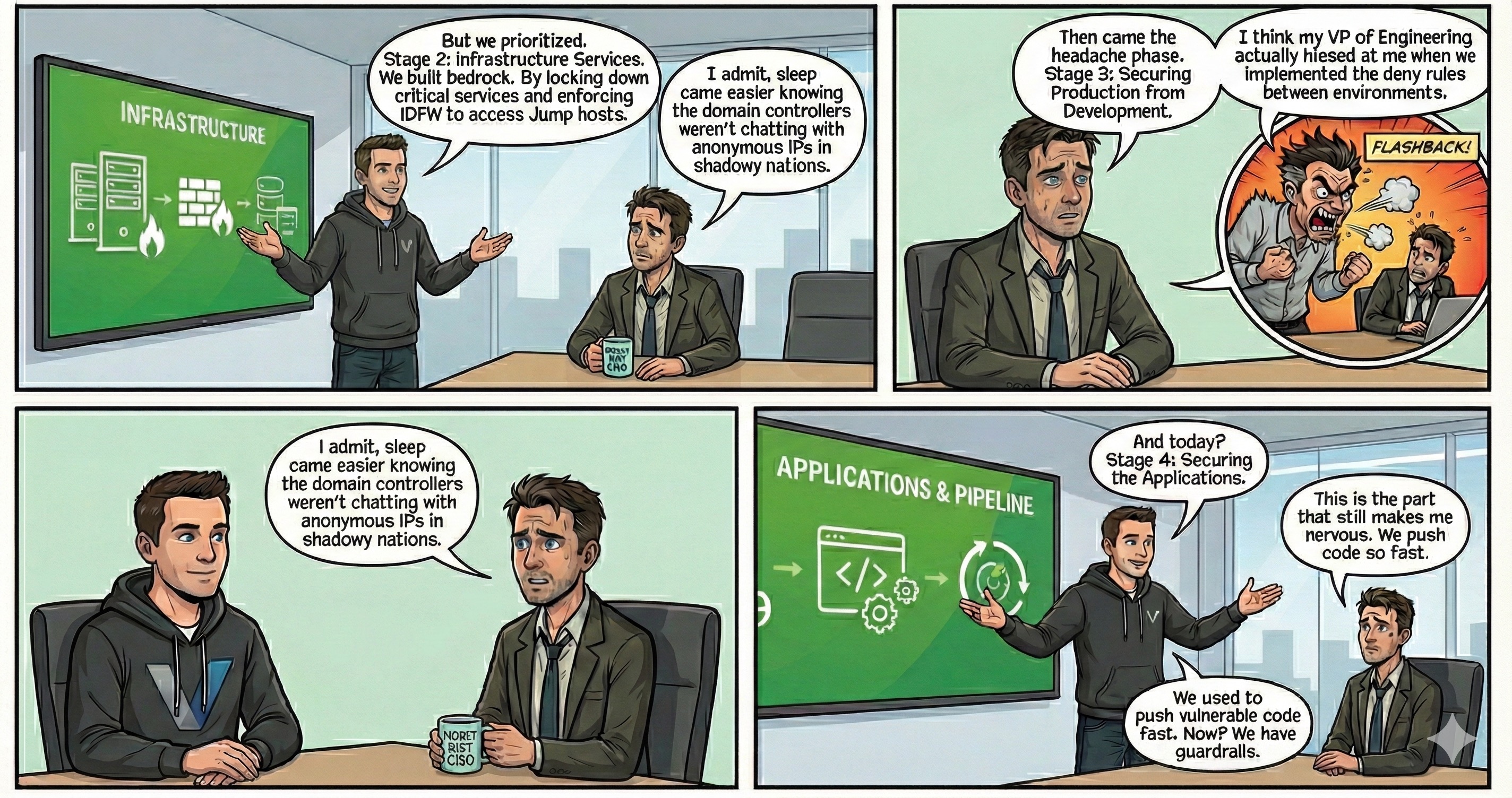



 vPSO
vPSO 