

If you’ve been reading my recent posts on vPSO, you know I care about connecting theoretical security frameworks with real-world use in VMware Cloud Foundation (VCF). We’ve looked at how VMware vDefend serves as the main enforcer for NIST SP 800-53 Rev. 5, NIST SP 800-207 (Zero Trust), and NIST SP 800-82 Rev. 3 (OT/ICS).
Recently, NIST released an important document: NIST SP 800-239 (Initial Public Draft), titled “AI Data Center Security Analysis: A High-Performance Computing (HPC) Driven Approach.” If your organization is building AI infrastructure—whether for fine-tuning Large Language Models (LLMs), Retrieval-Augmented Generation (RAG) pipelines, or real-time inference—this publication is essential reading.
In this post, we’ll explain what NIST SP 800-239 is, why traditional data center security doesn’t work well in AI settings, and how to use VMware Avi Load Balancer (AVI) and VMware vDefend together to achieve the main objectives of this framework.
What is NIST SP 800-239 and Why Is It Different?
Traditional enterprise data centers are built around predictable application tiers (Web -> App -> DB).
AI data centers, however, inherit their architectural DNA from High-Performance Computing (HPC) environments. They feature:
- Massive East-West Traffic: Unprecedented east-west bandwidth utilization across GPU clusters, high-speed interconnects, and distributed storage.
- Complex Open-Source Software Stacks: Rapid adoption of fast-evolving tools like PyTorch, Ray, vLLM, Ollama, LangChain, and vector databases (e.g., Milvus, Pinecone, pgvector).
- High-Value Assets: Highly sensitive intellectual property stored in model weights, training datasets, and prompt history.
- Heavy API Exposure: Public or internal AI inference endpoints processing continuous streams of unstructured query payloads.
NIST SP 800-239 performs a comprehensive threat and gap analysis on these environments, identifying key risk areas such as Inference API exploits, prompt injection, compute exhaustion (DDoS on expensive GPU resources), data poisoning, model exfiltration, and lateral movement across high-speed fabrics.
To solve these challenges, we need a two-pronged defense strategy:
- North-South Edge Protection & API Management: Guarding the entry points into AI inference and RAG pipelines (VMware Avi Load Balancer).
- East-West Distributed Security & Micro-segmentation: Protecting internal workloads, model registries, vector databases, and GPU worker nodes (VMware vDefend).
Architectural Breakdown: Dividing North-South & East-West in AI Infrastructure
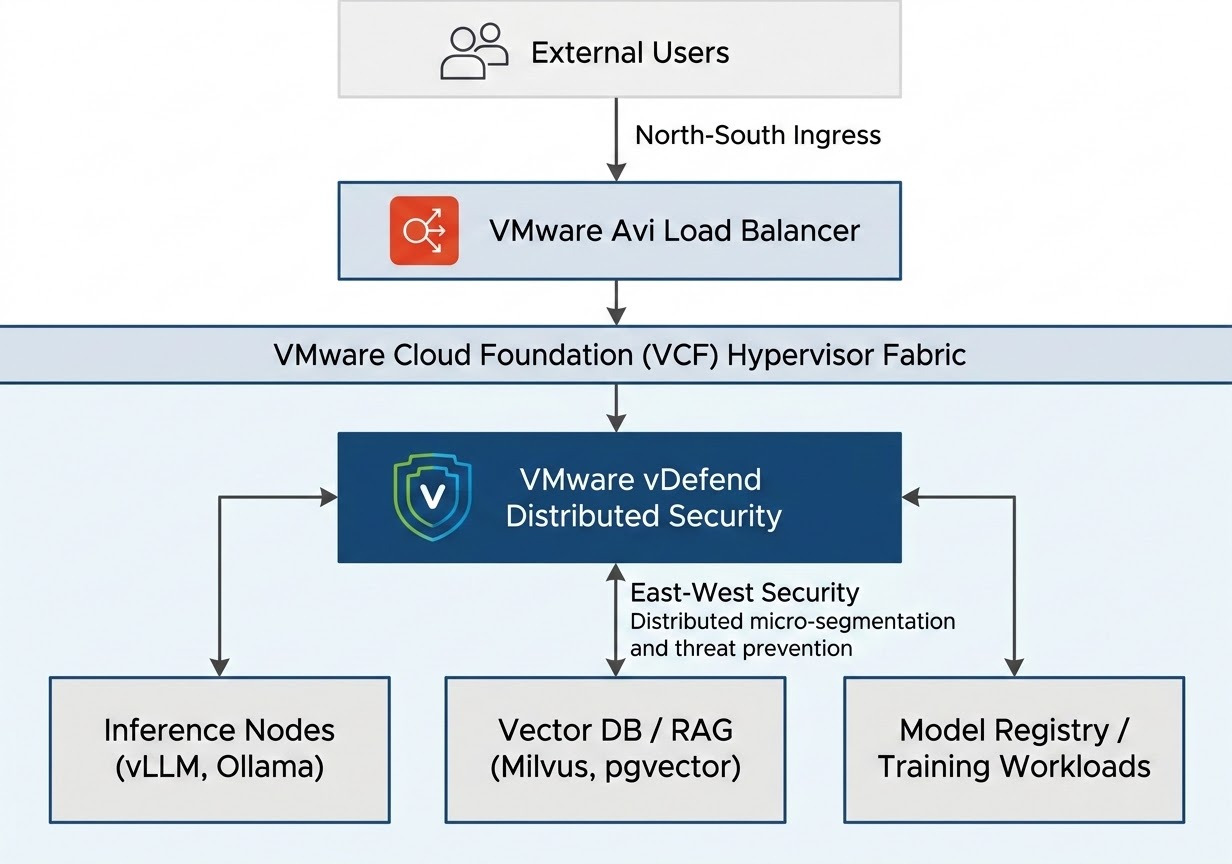
Deep Dive 1: Guarding the Front Door with VMware Avi Load Balancer
NIST SP 800-239 emphasizes that AI endpoints are prime targets for resource starvation and application-level exploits. Because AI inference queries consume significant GPU compute cycles, an unthrottled API endpoint can quickly lead to severe denial-of-service or astronomical cloud/compute bills.
Here is how VMware Avi Load Balancer delivers on NIST SP 800-239 North-South requirements:
1. Advanced Web Application Firewall (WAF) & API Security
- OWASP for LLM Protection: Avi WAF inspects incoming HTTP/HTTPS payloads to detect malicious patterns, such as system prompt injections, SQL injections targeting vector store lookups, and Server-Side Request Forgery (SSRF) exploits designed to force inference servers to call unauthorized metadata services.
- Schema Validation & API Sanity: Enforces strict API schemas on OpenAPI/Swagger specifications for AI inference endpoints, dropping malformed payloads before they hit python-based API engines.
2. GPU Protection via Intelligent Rate Limiting & DDoS Mitigation
- Resource Exhaustion Defense: Standard HTTP rate-limiting isn’t enough when a single complex query can tie up multiple Tensor Core GPUs. Avi provides granular rate-limiting policies based on client IP, API token, or query parameters, protecting backend inference workers from compute-draining burst attacks.
- L4-L7 Analytics: Real-time visual metrics display latency spikes, client IP distributions, and abnormal payload sizes, enabling rapid diagnosis of attack traffic versus legitimate spikes in LLM usage.
3. SSL/TLS Offloading and Inspection
- High-performance SSL/TLS termination offloads crypto-processing from inference workloads, providing central inspection visibility into encrypted API streams prior to routing traffic to internal pods or VMs.
Deep Dive 2: Hardening the Internal AI Fabric with VMware vDefend
Once traffic crosses the perimeter, NIST SP 800-239 warns against assuming internal AI cluster components are safe. If an attacker compromises a web application server, they will attempt to move laterally to vector databases, extract proprietary fine-tuning data, or access model weights stored in model registries.
VMware vDefend provides kernel-level, Zero Trust lateral security natively within the hypervisor.
1. Zero Trust Micro-segmentation with Distributed Firewall (DFW)
- Granular Isolation: vDefend DFW allows you to enforce strict firewall rules directly at the vNIC layer of every virtual machine or container host (VKS/vSphere Supervisor).
- AI Pipeline Tiering: You can create logical security boundaries separating:
- Inference Front-Ends to —> allowed to talk ONLY to Vector Databases on specific API ports.
- Vector Databases to —> restricted from communicating directly with external egress gateways.
- Model Registries / Storage to —-> accessible ONLY by authenticated training or orchestration nodes.
2. Virtual Patching via Distributed IDPS (Turbo Mode)
- Protecting Fragile AI Software Stacks: Open-source AI tools evolve rapidly, creating a wide attack surface of unpatched CVEs (e.g., vulnerabilities in Ray, PyTorch, or LangChain).
- Hypervisor-Enforced DPI: vDefend Distributed Intrusion Detection and Prevention System (IDPS) inspects every packet passing through the vNIC. Using curated threat signatures, vDefend acts as a Virtual Patch, blocking exploit attempts at the hypervisor layer without requiring agent installations inside sensitive GPU guest operating systems.
3. Advance Threat Prevention (ATP) & Security Intelligence
- Detecting Model Weight Exfiltration: Extracting a 70B parameter model weight file involves transferring gigabytes of binary data over the network. vDefend Security Intelligence maps all East-West traffic flows visually.
- Threat Campaign Correlation: vDefend NDR correlates anomalous network behaviors—such as an inference node initiating a massive file transfer to an unauthorized staging server—alerting SOC teams before data exfiltration completes.
Mapping Matrix: NIST SP 800-239 Objectives to VMware Solutions
| NIST SP 800-239 Security Goal | Threat / Challenge Identified | VMware Solution | Operational Capability |
|---|---|---|---|
| Inference Endpoint Security | Malicious prompt injection, malformed API payloads, SSRF targeting RAG sources. | VMware Avi Load Balancer | Avi WAF & API Security inspecting L7 traffic; schema enforcement for AI endpoints. |
| Compute Availability & DoS Mitigation | GPU compute exhaustion via malicious or excessive query flooding. | VMware Avi Load Balancer | L4-L7 Rate Limiting, DDoS protection, and traffic shaping tailored to heavy AI workloads. |
| East-West Containment | Unrestricted lateral movement between compromised web tiers and AI infrastructure. | VMware vDefend DFW | Kernel-level Zero Trust micro-segmentation isolating inference nodes, vector DBs, and model stores. |
| Software Stack Vulnerability Shielding | Zero-day exploits and CVEs in rapid-release open-source AI frameworks (PyTorch, Ray, etc.). | VMware vDefend IDPS | Virtual Patching using IDPS Turbo Mode to drop exploit packets before reaching vulnerable services. |
| Data & Model Exfiltration Defense | Unauthorized theft of model weights, training data, or prompt logs across the internal network. | VMware vDefend ATP & Security Intelligence | Flow visualization, anomalous traffic detection, and threat campaign correlation for massive data transfers. |
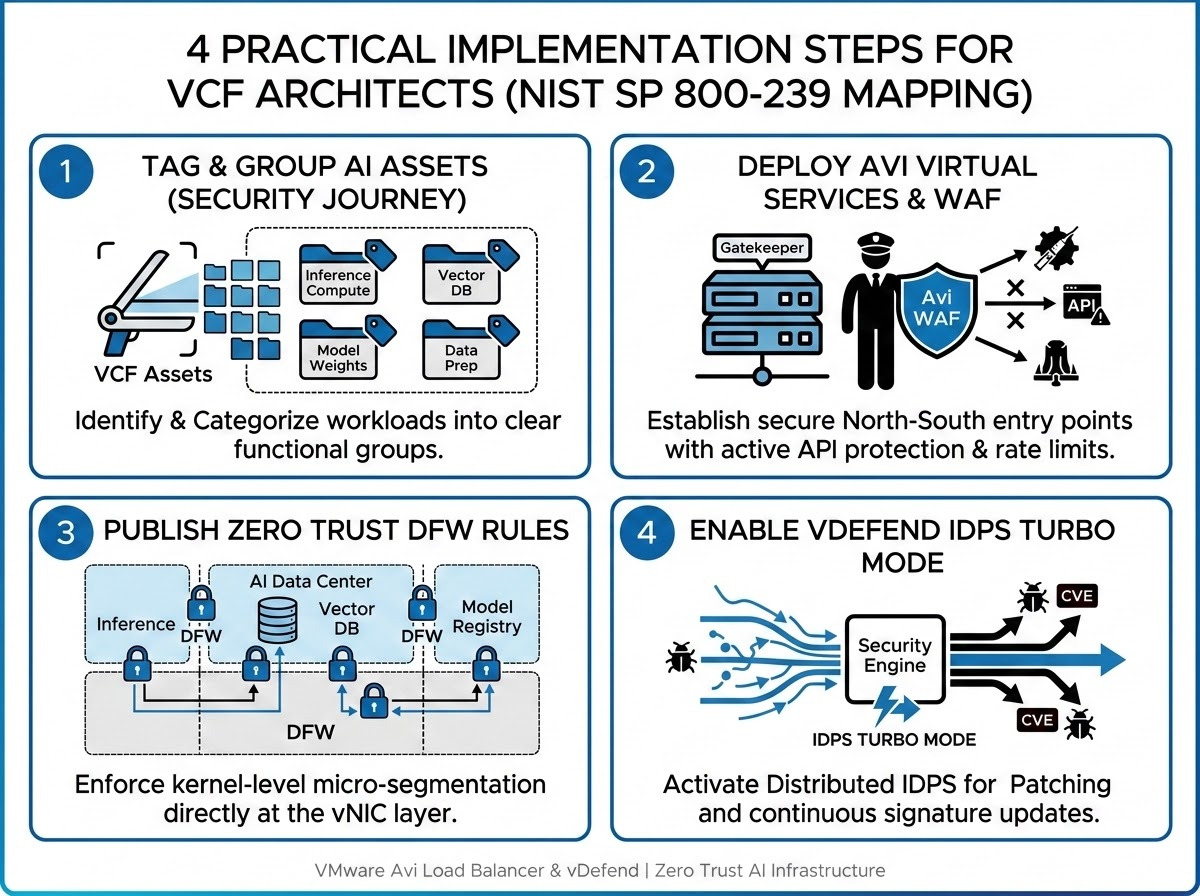
Practical Implementation Steps for VCF Architects
Ready to operationalize NIST SP 800-239 in your VCF environment? Follow this 4-step workflow:
Conclusion
NIST SP 800-239 makes one thing clear: AI infrastructure cannot be secured using legacy perimeter-only methods. The combination of high-value data assets, compute-intensive workloads, and complex software stacks demands a unified defense strategy.
By deploying VMware Avi Load Balancer at the ingress boundary and VMware vDefend natively within the VCF hypervisor fabric, you establish a resilient, end-to-end Zero Trust architecture capable of protecting your next-generation AI data centers.
Join the Conversation!
How is your organization securing AI workloads and RAG pipelines today? Have you started mapping NIST SP 800-239 into your architecture standards? Drop a comment below or reach out on LinkedIn—I’d love to hear how you’re tackling lateral security in the era of AI!
Don’t forget to subscribe to vPSO for more deep dives into VMware Cloud Foundation, Zero Trust architecture, and cybersecurity compliance!


Leave a Reply